

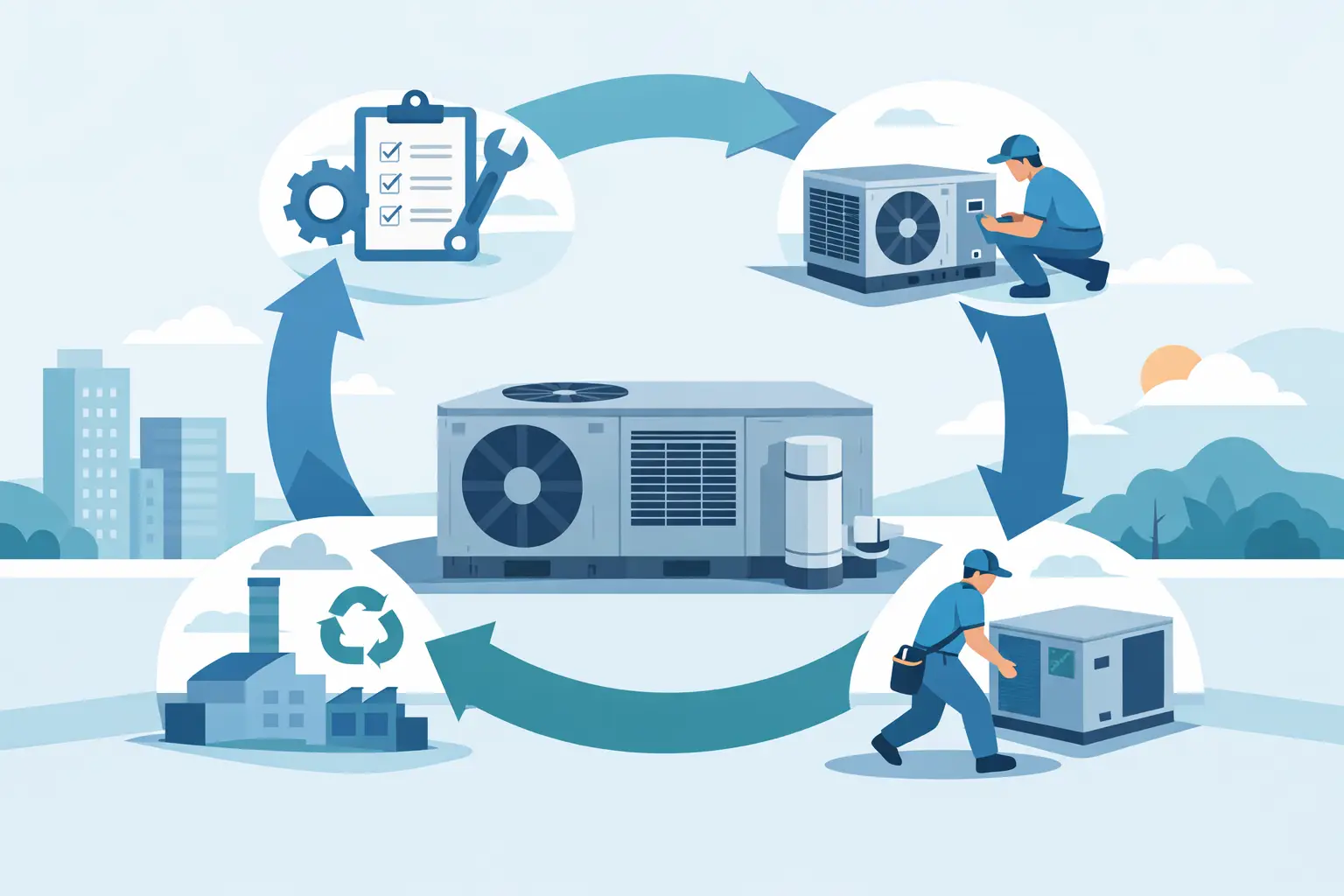
HVAC Asset Lifecycle Planning Guide for Businesses
A failed condenser on the hottest day of the year is rarely just a repair bill. It can mean lost trading, uncomfortable staff and customers, interrupted IT operations, and an urgent replacement decision made with little control over cost or specification. This HVAC asset lifecycle planning guide explains how commercial operators can replace reactive decision-making with a practical, evidence-led plan for every system on site.
The aim is not to keep ageing equipment running indefinitely. It is to make informed choices about maintenance, repair, upgrade and replacement at the right point in each asset’s working life. Done properly, lifecycle planning supports uptime, energy control, legal compliance and clearer capital budgeting.
What HVAC lifecycle planning means in practice
HVAC asset lifecycle planning is the process of recording the equipment you own, assessing its condition and performance, forecasting its likely needs, and setting out what action will be taken and when. It applies to air conditioning, ventilation, heat recovery ventilation, refrigeration where relevant, controls and associated electrical components.
A useful plan answers straightforward operational questions. Which units are critical to the business? Which systems are covered by warranty? Where are recurring faults occurring? Which assets are becoming expensive to run or difficult to repair? What level of spending is likely over the next one, three and five years?
This creates a distinction between a maintenance programme and a lifecycle plan. Planned preventative maintenance keeps equipment safe, clean and efficient now. Lifecycle planning uses maintenance findings, repair history and asset data to decide what should happen next. Both are required. Without PPM, condition data is weak; without a lifecycle view, maintenance can become a sequence of short-term fixes with no clear investment strategy.
Start with an accurate asset register
An asset register is the foundation of effective planning. Many sites have a partial list of outdoor units but no reliable record of indoor units, controls, ventilation equipment or the systems serving specific areas. That makes it difficult to prioritise work, demonstrate compliance or understand the true replacement exposure across an estate.
For each asset, record the manufacturer, model, serial number, location, installation date where known, refrigerant type and quantity, warranty status, service history and any known issues. It should also show what the equipment serves. A small split system in a meeting room does not carry the same risk as cooling equipment protecting a server room, production area or occupied retail floor.
Condition should be recorded consistently rather than described simply as good or poor. A practical grading system can identify whether an item is operating normally, needs monitoring, needs planned remedial work or is approaching replacement. This allows facilities teams to compare assets fairly, even across multiple sites.
Where records are incomplete, a professional site survey is usually the quickest route to a dependable baseline. It also provides an opportunity to identify access constraints, ageing controls, damaged insulation, poor airflow and installation issues that may not be apparent from a desk review.
Assess criticality before setting priorities
Age alone is not a replacement plan. A well-maintained ten-year-old system in a low-demand area may remain a sensible asset to retain. Conversely, a newer unit serving a critical environment may warrant closer monitoring because its failure would have a disproportionate business impact.
Assess every asset against its operational criticality. Consider the consequences of failure, the availability of temporary cooling or ventilation, the ease of sourcing parts, occupant dependency, seasonal demand and whether the system supports a compliance-sensitive environment.
For example, a comfort cooling unit in a lightly used office can often be scheduled for repair at a convenient time. A failed system in a comms room, hospitality kitchen or data environment may require an immediate response and a resilience plan. This may involve duty/standby equipment, remote alerts, spare parts held in reserve or a defined emergency replacement route.
Criticality also helps prevent budget being absorbed by the loudest complaint rather than the most significant risk. The system receiving the most calls is not always the asset that presents the greatest operational exposure.
Use maintenance data to spot the repair-or-replace point
The repair-or-replace decision should be based on total operational value, not a single invoice. A compressor repair may be justified where the system is otherwise reliable, efficient and supported by the manufacturer. It becomes less attractive when the same asset has repeated faults, obsolete parts, refrigerant constraints, poor seasonal performance and a growing maintenance burden.
Review repair history alongside energy use, breakdown frequency and anticipated remaining life. Repeated call-outs are a clear warning sign, but so are longer lead times for parts and temporary workarounds that disrupt the site. A unit can still appear to be running while quietly increasing electricity consumption and reducing occupant comfort.
When comparing replacement options, include the wider work required to make the new system effective. This may include controls upgrades, pipework alterations, electrical capacity, condensate drainage, ventilation changes and access equipment. A low initial equipment price can be misleading if it leaves poor zoning, inadequate control or future maintenance difficulties unresolved.
There is also a timing trade-off. Replacing too early can waste useful asset life. Waiting until failure can force a rushed purchase during peak demand, with greater downtime and fewer specification choices. Lifecycle planning identifies a planned replacement window, allowing the business to obtain surveys, review options and complete work during quieter periods.
Build compliance and warranty protection into the plan
Compliance should not sit in a separate folder from asset management. Refrigerant-containing equipment requires appropriate handling and servicing by qualified engineers, while the records of checks, refrigerant use and repairs need to be available when required. A structured service programme helps maintain the documentation needed to support F-Gas responsibilities and demonstrate appropriate management of equipment.
Warranty conditions should be checked at the same time. Manufacturers commonly expect commissioning records, specified maintenance intervals and work completed by competent engineers. Missing service evidence may weaken a warranty claim precisely when a major component fails.
The lifecycle plan should also identify equipment using refrigerants that may create future cost or availability concerns. This does not automatically mean every affected system needs immediate replacement. The right response depends on condition, leakage risk, parts support, system criticality and the practicality of conversion or replacement. However, it is far better to identify the exposure early than to discover it during an urgent breakdown.
Turn the plan into a funded programme
A lifecycle plan is only useful if it influences maintenance schedules and budgets. Divide work into immediate remedials, planned efficiency improvements, medium-term repairs and future capital replacement. This separates safety, compliance and continuity work from desirable upgrades, making approvals more straightforward.
A rolling three-to-five-year view is often enough for most commercial sites. It provides visibility of likely replacement clusters, particularly where a building was fitted out in one phase and multiple units are likely to age together. Multi-site operators should also look for standardisation opportunities. Using compatible equipment and control approaches can simplify training, spares, servicing and reporting, although site-specific requirements must still be respected.
Your programme should be reviewed after major repairs, changes in occupancy, energy performance concerns, refurbishments or repeated breakdowns. It is not a document that should be written once and left untouched. Each service visit adds useful evidence about the condition and future prospects of the asset.
A practical HVAC asset lifecycle planning guide for site teams
For facilities and operations teams, the most reliable approach is to make lifecycle review part of normal building management. Keep the asset register current, retain service and compliance records, and ask for clear condition findings after each visit. Reports should explain the business implication of a defect, not merely state that a part is required.
Set regular review points with your maintenance provider, particularly before summer demand places greatest pressure on air conditioning systems. Discuss assets approaching a replacement decision, likely lead times, budget ranges and any resilience gaps. This gives decision-makers time to approve work on commercial terms rather than under emergency conditions.
For smaller premises, this process may be relatively simple: a concise asset list, annual service records and a forecast for the main systems. For larger estates, it may involve detailed condition surveys, site-by-site risk rankings and a phased investment programme. The principle remains the same: maintain what is viable, improve what is underperforming and replace equipment before failure dictates the timetable.
A dependable engineering partner should make that process easier by combining planned maintenance, responsive repairs, compliance documentation and clear replacement advice. Optim PRO supports Midlands businesses with tailored servicing programmes designed around the systems they operate and the continuity they require.
The best time to plan an HVAC replacement is while the existing system is still operating. That is when your business has the most choice, the strongest negotiating position and the least disruption to manage.