
Repair or Replace Aircon? A Business Decision
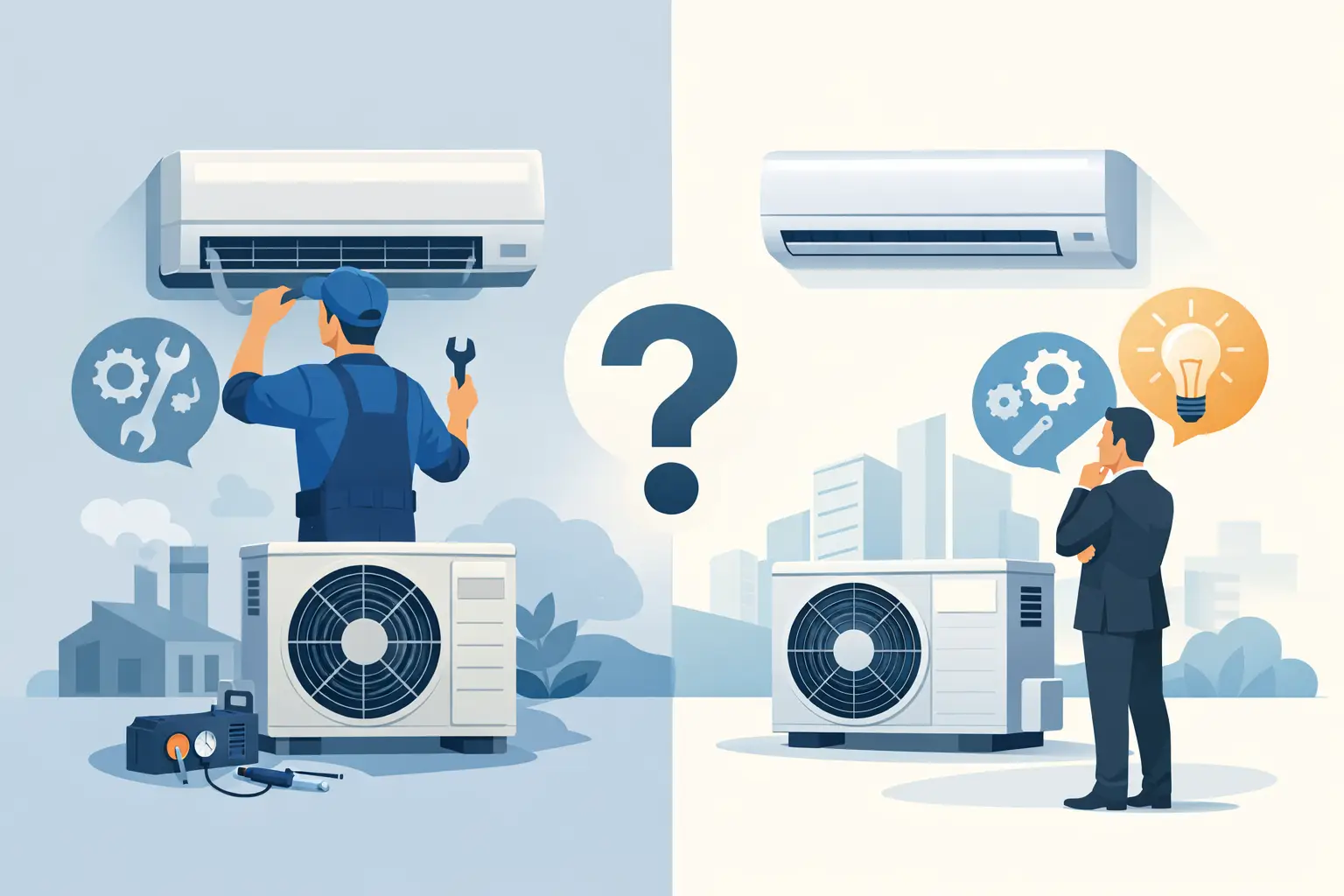
A failed air conditioning unit rarely arrives at a convenient time. It can leave an office too hot to work in, put stock at risk in a retail setting, affect guest comfort in hospitality, or create a serious resilience issue in a comms room or data centre. When deciding whether to repair or replace aircon, the right answer is not simply the lowest immediate quote. It is the option that best protects uptime, compliance, energy performance and your budget over the remaining life of the asset.
For a relatively new, well-maintained system, a targeted repair is often sensible. For an ageing unit with repeat faults, poor efficiency or an obsolete refrigerant, replacement may offer better value even where the initial capital cost is higher. A proper engineering assessment brings the decision back to evidence rather than guesswork.
Repair or replace aircon: start with the system’s condition
Age matters, but it should not be used in isolation. A high-quality commercial system that has received planned maintenance may continue to operate reliably beyond its expected service life. Conversely, a poorly maintained unit can become unreliable much sooner.
The first question is whether the current fault is isolated or symptomatic of wider deterioration. A failed capacitor, fan motor, condensate pump or control component can often be repaired economically, provided the compressor, heat exchangers, pipework and electrical systems remain in sound condition. One straightforward repair should not automatically trigger a replacement project.
The position changes when faults recur. Repeated refrigerant leaks, compressor failures, electrical issues or poor cooling performance can indicate that the unit is approaching the point where continued spending is difficult to justify. Each call-out may restore operation temporarily, but it also creates disruption, administration and uncertainty for the people using the building.
A competent assessment should examine the full system rather than the most visible fault. That includes indoor and outdoor units, refrigerant circuit integrity, drainage, filters, coils, controls, electrical connections and airflow. It should also consider whether the installed capacity still matches the way the space is used.
Compare whole-life cost, not just the repair invoice
A repair quotation can look favourable when placed beside a new installation cost. However, the purchase price is only one part of the decision. Facilities and operations teams should compare the likely cost of keeping the existing system running with the projected cost and benefit of replacement over several years.
Consider the repair cost alongside the unit’s age, its maintenance history, expected future repairs and the business impact of another failure. In a small meeting room, an occasional interruption may be manageable. In a server room, healthcare setting, busy shop floor or customer-facing venue, downtime can cost far more than the repair itself.
Energy consumption is another material factor. Older air conditioning equipment can draw significantly more electricity than a correctly specified modern alternative, particularly if coils are dirty, refrigerant levels are incorrect or controls no longer operate accurately. A replacement system may provide improved seasonal efficiency, more precise temperature control and better zoning. These gains should be assessed against actual operating hours and tariffs, rather than assumed.
It is also worth checking what is included in each option. A sound repair proposal should identify the fault, required parts, labour, testing and any recommendations arising from the inspection. A replacement proposal should cover design, capacity, installation, commissioning, controls, condensate arrangements, electrical requirements, removal of old equipment and handover documentation. Comparing incomplete scopes is a common cause of unexpected cost.
Refrigerant and compliance can change the decision
For commercial operators, air conditioning is not simply a comfort system. It is an asset with environmental and legal responsibilities. Equipment containing fluorinated greenhouse gases must be managed by appropriately certified engineers, with leak checks and records where applicable.
Older systems may use refrigerants that are increasingly costly, restricted or difficult to source. If a major leak occurs on equipment using an obsolete refrigerant, repairing it may be technically possible but commercially weak. The cost of recovering refrigerant, locating the leak, repairing pipework, pressure testing, evacuating and recharging the system can become substantial, with no guarantee that another weakness will not emerge elsewhere in the circuit.
Replacement can reduce exposure to refrigerant availability issues and may lower the system’s environmental impact. It also provides an opportunity to correct historic shortcomings, such as poor access for servicing, inadequate drainage or a layout that makes consistent comfort difficult to achieve.
Compliance documentation should be treated as part of the service, not an optional extra. Clear maintenance records, F-Gas documentation and commissioning information help demonstrate that assets are being managed responsibly. They also support landlord obligations, insurer requirements, internal audits and manufacturer warranty conditions.
When repair is usually the right option
Repair is commonly the sensible route where the unit is within a reasonable stage of its life, has been reliably maintained and the fault is clearly identified. It is particularly appropriate when replacement parts are readily available, the refrigerant remains viable and the repair restores the system to expected performance.
A repair can also be the right short-term operational decision where replacement cannot be completed without unacceptable disruption. A critical site may need cooling restored immediately, then a replacement programme can be designed and scheduled around business activity. There is no benefit in forcing an unplanned replacement that creates greater risk than a controlled interim repair.
That said, a repair should not be presented as a permanent solution when the evidence suggests otherwise. A professional contractor should be clear about the likely remaining life of the equipment, any known risks and the level of confidence attached to the repair.
When replacement becomes the stronger investment
Replacement is generally worth serious consideration when repair costs are rising, faults are becoming more frequent or the system no longer delivers adequate cooling or heating. Persistent comfort complaints, excessive noise, water leaks and uneven temperatures are operational signs that should not be ignored.
It may also be appropriate where the premises have changed. An office reconfigured for higher occupancy, a retail unit with new heat-generating equipment, or a converted space with increased solar gain may have demands the original air conditioning was never designed to meet. Replacing like-for-like without reviewing the load can repeat the original problem.
Modern systems can offer features that improve both usability and cost control. These may include inverter-driven compressors, individual room control, remote monitoring, heat recovery options and more efficient operation at part load. The benefit depends on the site, but in buildings with varied occupancy or long operating hours, better controls can be as valuable as the equipment itself.
For multi-site businesses, planned replacement can also improve standardisation. Common equipment types, documented asset registers and consistent service arrangements make budgeting, spare parts planning and maintenance easier across an estate.
Use a structured decision process
The strongest decisions are based on a site survey and a transparent recommendation. Start by confirming the fault and the immediate requirement for cooling, heating or ventilation. Then review the system’s age, service history, refrigerant, repair record, energy performance and the consequence of future downtime.
Next, request realistic options. This may include a repair with a stated expectation of remaining service life, a phased replacement plan, or a full replacement proposal with projected operational benefits. For critical environments, the review should also examine resilience. A single point of failure may justify additional capacity, duty and standby arrangements, or monitoring rather than a simple equipment swap.
Finally, consider how the chosen option will be protected. Planned preventive maintenance is what turns a capital investment or repair into dependable performance. Regular filter and coil cleaning, electrical checks, drainage inspection, leak monitoring and performance testing reduce avoidable failures and help maintain efficiency. It also gives managers earlier warning when a repair-versus-replacement decision is approaching.
Avoid making the decision in the middle of a failure
The least favourable time to replace air conditioning is often during a heatwave, a major tenant complaint or an unplanned shutdown. Emergency work may still be necessary, but it limits specification choices, scheduling flexibility and budget control.
A condition review carried out during routine servicing allows a business to plan ahead. Replacement can then be timed around quieter trading periods, refurbishments, lease events or financial planning cycles. It gives decision-makers time to assess capacity, obtain a properly scoped proposal and minimise disruption to occupants.
Optim PRO supports Midlands businesses with repairs, planned servicing and compliance-led assessments that make this decision clearer. The aim is not to replace equipment prematurely or prolong unreliable assets indefinitely. It is to give each site a practical route to dependable, efficient climate control.
If an air conditioning system is beginning to demand repeated attention, arrange an assessment before the next fault dictates the timetable. A clear view of asset condition and likely costs gives you the space to protect comfort, continuity and budget on your own terms.