

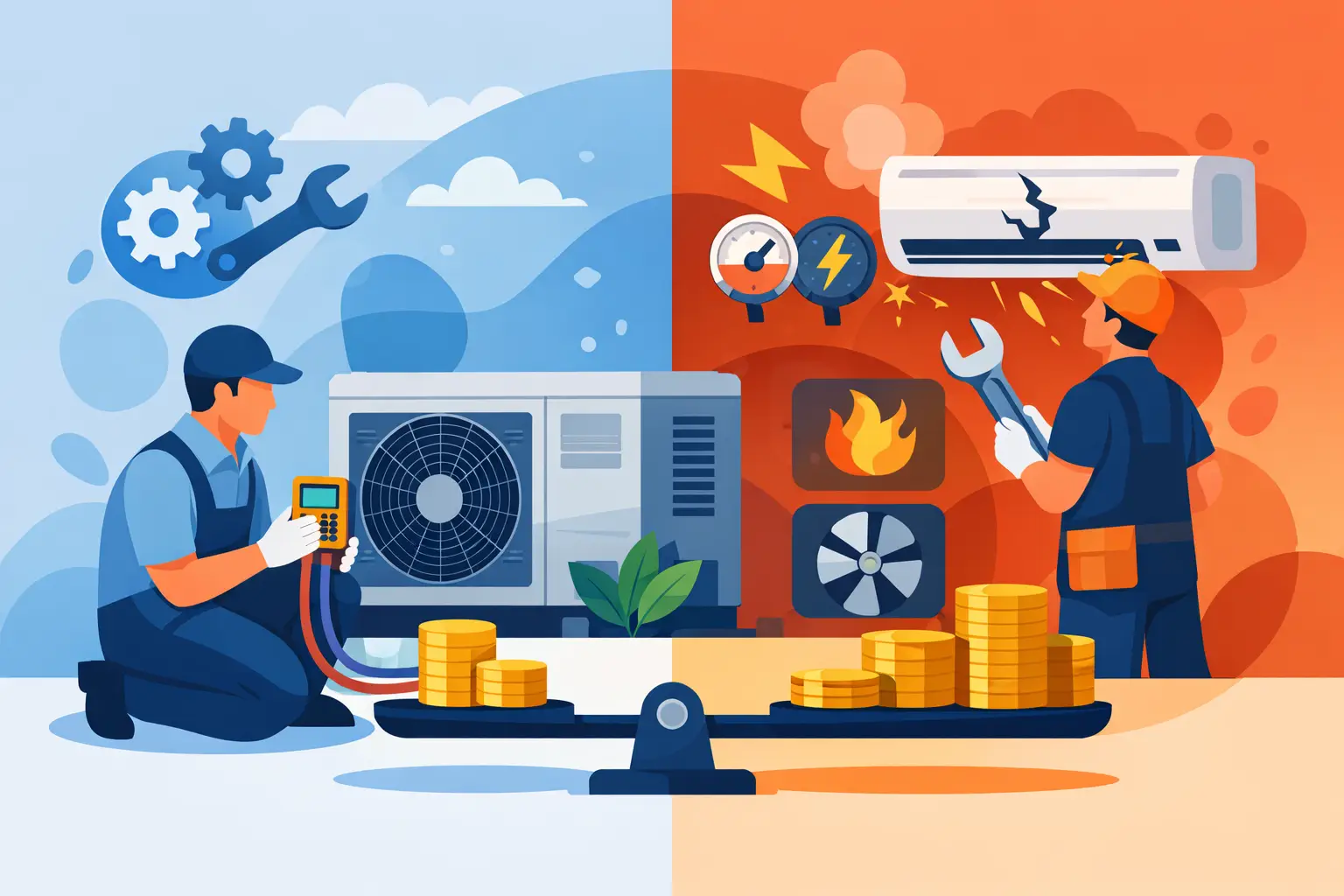
HVAC Maintenance vs Repair: Which Costs Less?
A failed air conditioning unit rarely arrives at a convenient time. It tends to happen during a heatwave, before a customer visit, in the middle of a busy service period or when a critical room needs stable temperatures most. That is why the decision around HVAC maintenance vs repair is not simply a question of engineering spend. For commercial operators, it is a decision about downtime, compliance, energy use and the working environment.
Repair work has a clear place when equipment develops a fault. Planned maintenance has a different purpose: finding deterioration early, keeping equipment operating efficiently and providing the records needed to manage assets responsibly. The most cost-effective approach is usually not choosing one over the other. It is using planned servicing to reduce reactive repairs, while retaining access to qualified engineers when a genuine failure occurs.
HVAC maintenance vs repair: the key difference
HVAC maintenance is scheduled work carried out to preserve the condition and performance of an air conditioning, ventilation, heat pump or heat recovery system. A service visit may include cleaning filters and coils, checking condensate drainage, inspecting electrical connections, reviewing operating pressures and temperatures, testing controls, and identifying worn components before they stop the system.
HVAC repair is corrective work. It is required after a fault has been identified, such as a refrigerant leak, failed fan motor, electrical fault, blocked drain, damaged control board or compressor issue. The engineer diagnoses the cause, supplies or sources the necessary parts, and returns the equipment to safe operation where repair remains commercially sensible.
The distinction matters because a system can appear to be working while its condition is declining. A dirty coil, partially blocked filter or poor refrigerant charge may not cause an immediate shutdown, but it can increase running costs, reduce cooling capacity and place extra strain on major components. Maintenance addresses these developing issues before they become an urgent repair call.
Why reactive repair alone can cost more
A repair-only approach may seem economical when a system is relatively new or used infrequently. There is no regular service invoice, and expenditure only happens when something goes wrong. The weakness is that faults are then discovered at the point of failure, when options are limited and the business needs a quick resolution.
An urgent breakdown can bring costs beyond the engineer’s visit. A retail environment may become uncomfortable for customers and staff. An office may lose productivity during hot weather. Hospitality venues can face complaints, while IT rooms, plant areas and other critical spaces may be exposed to operational risk if temperature control is lost. In these situations, the commercial cost of disruption can exceed the cost of the repair itself.
Reactive work can also be less predictable. Parts may need to be ordered, access equipment may be required, or a fault may reveal a wider issue that has developed over time. Planned maintenance does not eliminate every breakdown, particularly where equipment is ageing or heavily used, but it gives building operators more opportunity to budget, schedule remedial work and avoid peak-season pressure.
What planned maintenance protects
A well-structured maintenance programme is an asset-management tool, not a box-ticking exercise. Its value comes from the condition information gathered during each visit and the action taken from it.
Energy efficiency and running costs
Air conditioning systems work harder when airflow is restricted, coils are dirty or controls are not operating correctly. That extra effort increases electricity consumption and can shorten component life. Routine cleaning and performance checks help equipment deliver the required comfort with less wasted energy.
The savings will vary by system type, operating hours, occupancy levels and existing condition. A lightly used unit in a small office will not produce the same savings as a heavily loaded system serving a restaurant, warehouse office or multi-room commercial site. However, early attention to declining performance is consistently cheaper than allowing a minor issue to develop into major component damage.
Uptime and business continuity
Maintenance enables engineers to identify warning signs such as unusual noise, deteriorating electrical readings, poor drainage, fluctuating temperatures or declining refrigerant performance. These findings can be logged and prioritised, allowing work to be planned around your operation rather than forced into a costly emergency.
For multi-site estates and critical environments, this visibility is particularly valuable. Facilities teams need to know which assets need monitoring, which require repair, and which are reaching the point where replacement planning is more sensible than continued spend.
Compliance and warranty confidence
Commercial HVAC equipment can carry obligations around safe operation, refrigerant handling and record keeping. F-Gas requirements can include leak-checking duties depending on the type of refrigerant and the system’s CO2 equivalent charge. Manufacturer warranties may also require evidence of regular servicing by suitably qualified engineers.
A planned service programme creates an auditable maintenance history, records defects and supports informed compliance management. It does not remove every legal responsibility from the duty holder, but it gives landlords, building owners and facilities managers a stronger basis for demonstrating that systems have been professionally maintained.
When repair is the right response
Not every issue requires a broader maintenance programme or immediate replacement. Repair is often the correct and proportionate response when the equipment is otherwise in good condition, the fault is isolated, parts are available and the expected remaining service life justifies the cost.
For example, replacing a failed capacitor, fan motor or drain pump on a well-maintained system can restore dependable operation at a sensible cost. Similarly, a refrigerant leak can often be repaired, pressure tested and recommissioned where the leak source is accessible and the unit is not approaching obsolescence.
The decision becomes more complex when repairs are recurring, refrigerant is no longer readily available, energy consumption is high, or a major component such as a compressor has failed on an older unit. At that point, a repair quotation should be assessed alongside replacement costs, expected efficiency gains, warranty cover and the operational risk of keeping an ageing asset in service.
A dependable contractor should explain these trade-offs clearly. The cheapest immediate option is not always the lowest-cost decision over the next three to five years.
Building the right servicing plan
The right maintenance frequency depends on equipment type, age, usage and the consequence of failure. A lightly used wall-mounted unit in a small office has different needs from a multi-split system serving a busy retail premises or a close-control installation supporting critical equipment.
A practical programme starts with a site survey and asset review. This establishes what equipment is installed, where it is located, how it is used and what service history is available. From there, maintenance can be tailored around seasonal demand, operating hours and compliance needs.
For many commercial sites, regular planned visits allow filters, coils, drains and electrical components to be checked before summer demand exposes underlying problems. Systems operating year-round, or those supporting sensitive spaces, may need more frequent inspection. The objective is not to over-service equipment. It is to apply the right level of attention to the risk and value of each asset.
At Optim PRO, this approach combines planned preventive maintenance, clear service documentation and responsive repair support, helping Midlands businesses protect system performance without losing sight of budget control.
Questions to ask before approving a repair
When a fault occurs, a clear diagnosis is more useful than a vague recommendation. Ask what has failed, why it failed, whether the issue is likely to recur, and how the repair affects the system’s expected lifespan. You should also understand whether the unit is operating efficiently after repair and whether any related defects need attention.
For larger repairs, request a comparison between repairing and replacing. This should account for downtime, lead times, energy use, available warranties and the condition of the rest of the installation. If a unit is part of a wider system, one failed component may also indicate that other units need inspection.
Service records are valuable here. A documented history can show whether the fault is isolated or part of a pattern. It also helps decision-makers move from reactive spending to a planned capital replacement strategy where needed.
The practical balance for commercial properties
Maintenance and repair are not competing services. Maintenance is the planned discipline that reduces avoidable failures and gives you better control over cost. Repair is the essential response when a fault still occurs. Businesses that rely only on repair usually accept more uncertainty, while businesses that maintain systems without acting on identified defects may miss the point of the programme.
The strongest position is a service plan matched to the operational importance of your equipment, supported by prompt corrective work and honest advice when repair is no longer the sensible option. Treat HVAC as a working asset rather than an emergency expense, and it is far easier to protect comfort, compliance and continuity throughout the year.