
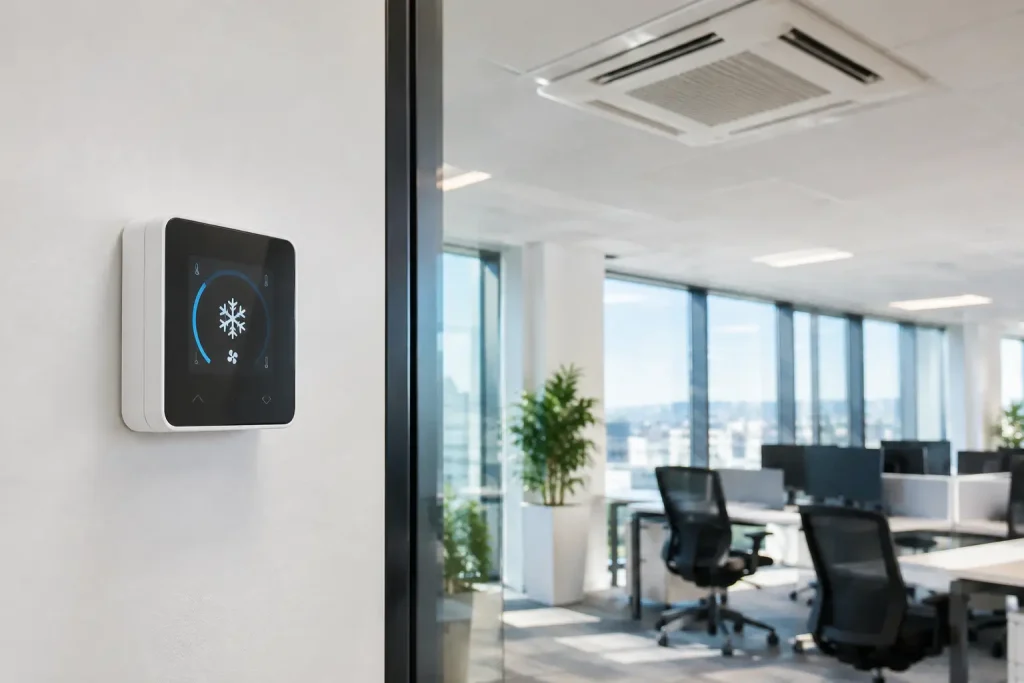
A meeting room that is comfortable at 9am but stuffy and overcooled by lunch rarely has a simple ‘thermostat problem’. The best office cooling controls match how the building is actually used, while allowing the air conditioning system to operate within sensible limits. For facilities managers, that means fewer comfort complaints, less unnecessary running and clearer control of a valuable building asset.
Controls matter most in offices and hotels with several indoor units, concealed ducted systems or VRF/VRV installations. A poorly set controller can make a sound system look unreliable. Equally, a well-specified controller cannot compensate for blocked filters, dirty coils, poor condensate drainage, refrigerant faults or restricted airflow. The two need to be managed together.
What makes the best office cooling controls?
There is no single controller that suits every commercial building. A small office with a few split units may benefit from straightforward, lockable wall controllers and sensible schedules. A multi-storey office or hotel with a VRF/VRV system may need centralised control, zoning and reporting that gives the building team a clearer view of operation.
The right choice depends on occupancy patterns, room use, the age and make of the system, access to existing controls and whether the plant can support the intended functions. A control upgrade should begin with an assessment of the whole installation rather than an assumption that a new touchscreen will resolve recurring complaints.
In practical terms, good cooling controls should provide consistent temperatures, prevent unnecessary operation outside occupied hours and make it difficult for individual users to apply extreme settings. They should also make faults easier to spot. If a unit is constantly calling for cooling but cannot reach setpoint, that is useful information for the maintenance engineer. It may point to an airflow, coil, refrigerant or outdoor-unit issue that needs investigation.
Start with sensible setpoints and user limits
Many office comfort problems begin with competing expectations. One person sets a room to 18°C, another switches it off because they are cold, and the unit then runs hard to recover when it is turned back on. This creates inconsistent conditions and can increase wear without solving the underlying concern.
A sensible setpoint range, agreed with the people responsible for the building, gives occupants a reasonable level of adjustment without allowing constant intervention. The exact setting will depend on the space, clothing expectations, heat gains, solar exposure and the system design. A south-facing glazed meeting room may need different treatment from a lightly occupied internal office.
Hotel settings need similar care. Guests expect direct control in bedrooms, but limits can help prevent the system being set to an unrealistic temperature and left running against an open window. Shared spaces such as reception areas, restaurants and corridors often benefit from centrally managed parameters, provided staff can still respond to genuine comfort issues.
Lockable settings are not about taking control away from occupants. They are about avoiding the cycle of extreme adjustments that leads to complaints, wasted energy and call-outs that could have been prevented through better control strategy.
Use schedules that reflect the building, not the clock on the wall
Time schedules are among the most useful office cooling controls, but they are often left untouched after installation. An office that once operated five long days may now have hybrid working patterns. A hotel conference suite may only be used on selected days. If air conditioning starts early and finishes late regardless of occupancy, the system can accumulate unnecessary run hours.
Schedules should allow adequate pre-conditioning where needed, particularly in spaces with high solar gain or high heat loads. However, an excessively early start time is not a substitute for investigating poor performance. If a meeting room needs three hours of cooling before use, the cause could be poor airflow, a dirty indoor coil, an incorrect control sensor location or equipment that is no longer delivering its intended capacity.
A useful maintenance review considers whether schedules are aligned with business use, whether holiday periods are accounted for and whether overrides are being used too often. Frequent overrides can indicate that the standard programme is unsuitable or that a system has a developing performance problem.
Zone the space carefully
Zoning is the difference between treating an entire floor as one environment and recognising that rooms have different loads and uses. Meeting rooms fill quickly, IT areas may run warm throughout the day, perimeter offices are affected by weather and solar gain, and hotel bedrooms have changing occupancy.
Where the system design allows it, separate zones can improve comfort and reduce avoidable operation. The trade-off is complexity. More zones mean more sensors, controls and settings to inspect, and poor commissioning can create conflicts between areas.
This is particularly relevant with VRF/VRV systems. Multiple indoor units may share outdoor equipment, and the available operating modes depend on the system arrangement. A request for one area to heat while another cools may not be possible on every installation. Before changing controls, it is worth confirming the system type, branch arrangement and original design intent.
Sensor position matters more than many people expect
A temperature sensor located near a sunny window, external door, printer bank or supply air grille will not represent the temperature experienced by most occupants. Concealed ducted systems can be especially vulnerable to this issue because the unit is out of sight and the room sensor becomes the main reference point.
A hypothetical example is a boardroom where the controller reads 21°C while people at the table feel warm. If the sensor is positioned close to a cool air supply, the system may reduce cooling before the occupied part of the room is comfortable. Moving or changing the sensing arrangement may help, but the engineer should first check airflow distribution, grille condition, filter cleanliness and whether the unit is producing the expected supply-air temperature.
Choose central oversight where it adds operational value
Centralised control is often worthwhile for larger offices, hotels and managed commercial buildings. It can allow authorised staff to set operating times, review alarms, identify units left running and apply consistent limits across similar areas. It also reduces reliance on a collection of handheld remotes that may be lost, incorrectly configured or used without visibility of the wider system.
For a facilities team, the value is not simply convenience. Central oversight can support better maintenance planning. Repeated alarm conditions, units with unusually long run times and areas that regularly miss setpoint can be reviewed during a planned preventative maintenance visit. That allows developing issues to be addressed before they become a disruptive failure.
Not every site needs a building management system or a major controls project. For a smaller premises, a practical upgrade may be as simple as replacing unreliable local controllers, setting a clear weekly programme and restricting unnecessary adjustment. The proportionate approach is the right one.
Controls only work when the air conditioning is maintained
It is easy to blame controls when cooling performance is poor, particularly if temperatures fluctuate or rooms take too long to cool. Yet a controller can only respond to the information it receives and the capacity available from the equipment.
Planned maintenance should look beyond a superficial filter clean. On commercial split, cassette, ducted and VRF/VRV systems, an engineer should consider filter condition, indoor and outdoor coil cleanliness, fan operation, airflow, condensate drainage, electrical connections, control responses and access for future servicing. Inaccessible filters or blocked condensate routes are common sources of avoidable disruption in concealed installations.
A recurring water leak, for example, may be caused by a blocked drain, failed condensate pump, poor pipe fall or excessive coil icing. Changing a setting will not fix it. Similarly, a noisy fan coil may need attention to the fan, filters, casing or airflow path rather than a new controller.
Maintenance records are also useful when considering control changes. They show whether there is a pattern of repeated faults, whether specific areas are difficult to maintain and whether repairs are becoming more frequent. This provides a stronger basis for deciding between a targeted repair, controls improvement or replacement planning.
Build controls into the PPM plan
Controls should be checked as part of a structured PPM programme, not only after complaints arise. The visit can include confirmation of time schedules, setpoints, sensor readings, controller response and visible alarms, alongside the mechanical and electrical checks required by the installation.
For offices and hotels across the Midlands, this work should be planned around occupancy where possible. Busy meeting rooms, guest areas and critical spaces may need different access arrangements from back-of-house plant areas. A clear maintenance plan helps reduce disruption and gives decision-makers a more predictable view of equipment care, even though no programme can prevent every future fault.
If your building has inconsistent temperatures, repeated overrides, water leaks or an unclear service history, OptimPRO can assess the complete air conditioning installation and provide a tailored PPM proposal for your premises.