
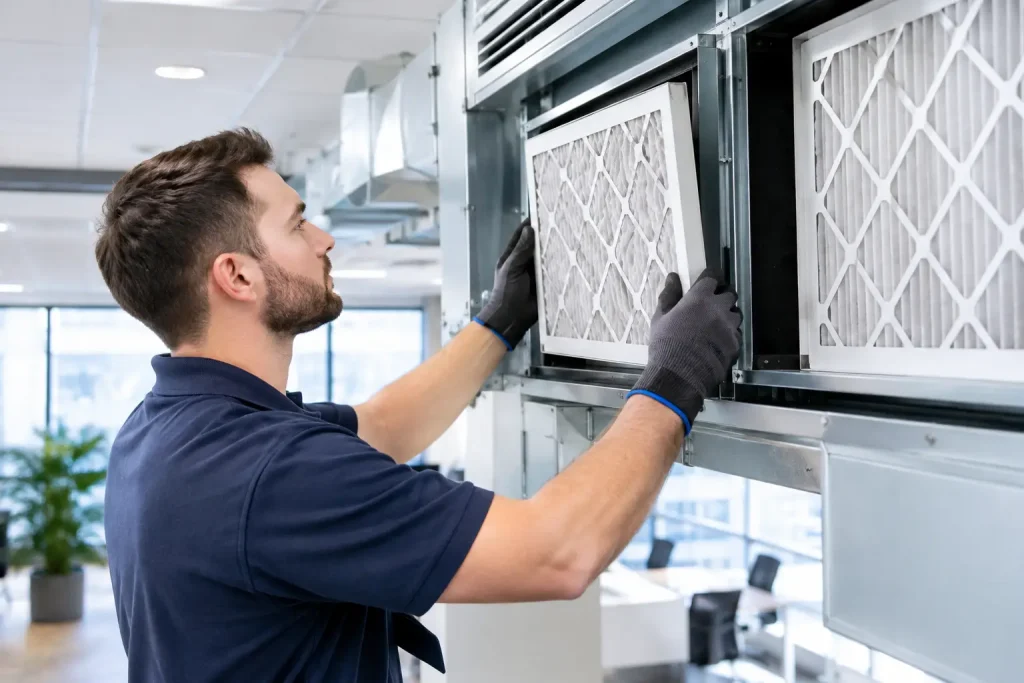
A blocked filter is rarely just a cleaning issue. In an office or hotel, it can be the first visible sign of reduced airflow, noisy operation, uneven temperatures and unnecessary strain on equipment. This air conditioning filter guide explains what commercial building managers should look for, why filter care belongs within planned preventative maintenance, and when a filter problem needs a wider investigation.
What air conditioning filters actually do
Filters protect the indoor section of an air conditioning system from airborne dust, fibres and other particulates. In a ceiling cassette or wall-mounted split system, this may be a washable mesh screen behind the front grille. In concealed ducted systems, air handling units and some VRF or VRV installations, filters may sit in return-air grilles, filter boxes or fan coil units above ceilings.
Their primary purpose is to keep debris away from the evaporator coil, fan and condensate system. When those components stay cleaner, the system has a better chance of moving the required volume of air and transferring heat effectively. The result is more stable comfort, less fan strain and reduced risk of dirt building up where it is harder to inspect.
That does not mean every filter should simply be cleaned and put back. The right approach depends on the type of filter, its condition, the manufacturer’s instructions, the building use and the available fan capacity. A disposable panel filter must be replaced, while a reusable mesh filter may be cleaned carefully and refitted once dry and undamaged.
Air conditioning filter guide for commercial premises
For facilities teams, the key question is not simply, “Are the filters dirty?” It is whether the filter condition is affecting the whole installation.
A heavily loaded filter increases resistance to airflow. The indoor fan then has to work harder to draw air through it, yet airflow at the supply grilles can still fall. Occupants may report that meeting rooms feel stuffy, hotel bedrooms take too long to cool, or one side of an office remains warmer than another. Where the system is already marginal because of poor duct balance, undersized return paths or ageing fans, a filter restriction can expose the underlying weakness quickly.
On a ducted installation, the engineer should consider filter access as well as filter condition. If reaching the filters requires lifting ceiling tiles above occupied desks, moving furniture or working around hotel room schedules, servicing can be postponed or done incompletely. Maintenance access is therefore an operational issue, not merely a design detail. A sensible PPM plan identifies inaccessible filters and recommends proportionate improvements before the problem becomes routine neglect.
Cleanable versus replaceable filters
Washable mesh filters are common in cassettes and smaller commercial split systems. They collect larger dust and lint particles and generally need regular removal, cleaning, drying and correct refitting. A filter that is refitted wet can encourage odours or introduce moisture where it is not wanted. Damaged mesh, cracked frames and poor sealing around the filter should also be addressed.
Replaceable filters are more common where a system needs greater particulate control or uses a dedicated filter section. They are available in different grades, and a higher-efficiency filter is not automatically the best choice. More filtration can mean more resistance to airflow. If a filter grade is changed without considering the fan duty, coil condition and system design, airflow and comfort can worsen rather than improve.
For this reason, any change to filter specification should be assessed against the equipment manufacturer’s requirements and the installation’s operating condition. In a hotel, for example, the right answer may differ between a busy entrance area, back-of-house spaces and guest accommodation.
How often should commercial filters be checked?
There is no responsible universal interval. A lightly used, well-managed office may need a different programme from a hotel with continuous occupancy, a retail site near a busy road or a building undergoing refurbishment. Dust levels, operating hours, occupancy patterns, nearby works and the type of return-air arrangement all matter.
As a starting point, filters should be inspected as part of scheduled air conditioning maintenance, with the frequency set after an initial assessment. A system that runs for long hours or supports frequently occupied meeting rooms may justify more regular attention than units serving occasional-use areas. The service record should show what was inspected, whether filters were cleaned or replaced, and whether the condition suggests that the maintenance interval needs adjusting.
A reactive approach often becomes expensive in disruption rather than parts cost. Consider a hypothetical office where a meeting room cassette repeatedly receives complaints for weak cooling. Cleaning the visible filter may improve it temporarily, but the actual cause could be a dirty coil, a partially blocked condensate drain, incorrect controller settings or insufficient return airflow above the ceiling. Repeated call-outs are likely if the visit stops at the filter.
A proper visit looks beyond the filter
Filter maintenance is valuable, but it is only one part of checking the system’s air side. A thorough commercial PPM visit should examine the condition and performance of connected components where accessible and appropriate.
This includes the indoor coil, fan wheel, condensate tray and drainage route. Dirt on a coil can restrict airflow and heat transfer even after a filter has been cleaned. A blocked or poorly draining condensate line can lead to water leaks, ceiling damage and guest or staff disruption. Fan contamination can contribute to noise, poor air movement and reduced efficiency.
Controls also matter. A room may feel uncomfortable because of a poorly positioned sensor, an unsuitable setpoint, a scheduling error or a communication fault between indoor and outdoor equipment. On larger VRF or VRV systems, an engineer should consider how individual indoor-unit concerns relate to the wider refrigerant system, controls and operating demand.
For concealed ducted units, the check should extend to accessible ductwork, return-air paths, grilles and insulation condition. A clean filter cannot compensate for a loose duct connection, crushed flexible duct, obstructed grille or inadequate access panel. The objective is to identify the cause of reduced performance, not merely improve the appearance of the unit.
Warning signs that filters need attention
Building managers do not need to remove filters themselves to spot a developing problem. The following symptoms justify a maintenance review, particularly when they recur:
- weaker airflow from grilles or cassette outlets;
- inconsistent temperatures between rooms or across the same open-plan area;
- increased fan noise or complaints of stuffiness;
- water leaks, musty odours or visible staining around indoor units; and
- more frequent faults or longer run times to achieve the usual temperature.
None of these symptoms proves that a filter is the cause. A refrigerant fault, failed fan motor, control issue, drainage restriction or ductwork problem may present in a similar way. That is why diagnosis should begin with inspection and testing rather than assumptions.
Using filter condition to improve maintenance planning
Filter condition can provide useful evidence for a longer-term maintenance plan. If filters are consistently dirty well before their scheduled visit, the service frequency may need revising. If they remain clean but rooms are still uncomfortable, the focus should move to airflow design, coil condition, controls or capacity.
A good PPM proposal should set out the assets covered, expected visit frequency, access requirements and the checks included. It should also distinguish routine maintenance from repairs and replacement parts, so budget responsibility is clear. This is particularly useful for managing agents and hotel operators who need to coordinate work around tenants, guests and occupied areas.
Maintenance cannot prevent every breakdown, especially on ageing equipment, but it can identify developing issues before they become an avoidable interruption. It also creates a clearer service history when deciding whether a recurring repair remains proportionate or replacement planning should begin.
For businesses across Nuneaton, Coventry, Birmingham and the surrounding Midlands, OptimPRO can assess filters as part of the complete air conditioning installation – including coils, drainage, airflow, controls and maintenance access. Contact the team to discuss your building’s systems and request a tailored PPM proposal that reflects how your premises actually operate.