A meeting room that is warm by 10am, a guest bedroom with a noisy fan coil, or water appearing below a ceiling cassette rarely starts as an overnight failure. In many cases, the warning signs have been building between irregular visits. So, how often should aircon be serviced in a commercial building? For most offices, hotels and managed properties, the sensible starting point is at least twice a year, with the final schedule based on how the system is used, its condition and the environment around it.
That answer is deliberately more useful than a blanket annual recommendation. A lightly used wall-mounted split in a small office has different needs from a hotel with occupied rooms every day, or a VRF system serving multiple floors through concealed ducted units. The right maintenance plan protects comfort and reliability without paying for activity that adds little value.
How Often Should Aircon Be Serviced?
For commercial air conditioning, two planned preventative maintenance visits per year is commonly an appropriate baseline. One visit can be arranged before the main cooling season, when systems will face their heaviest demand. The second can take place later in the year to check condition after sustained use, address developing issues and prepare equipment for the next operating period.
However, some systems need more frequent attention. Quarterly visits can be appropriate for busy hotels, premises with long operating hours, equipment serving critical spaces, or systems exposed to dust, grease or other airborne contaminants. A building with a history of drainage problems, recurring alarms or poor access to indoor units may also benefit from closer monitoring until the underlying issue is understood.
Annual servicing may be reasonable for a small, lightly used commercial system in a clean environment, provided its condition is good and there is a clear service record. It is less suitable as a default for a larger office, multi-let property or hotel where a failure affects numerous occupants, guests or trading activity.
The aim is not simply to choose a number of visits. It is to set an interval that gives an engineer a realistic chance to identify wear, contamination, restricted airflow and control faults before they become disruptive call-outs.
What Changes the Required Service Frequency?
Usage is the first consideration. Equipment running five days a week in an office will experience less run time than air conditioning operating throughout a hotel, a server room or a reception area. Longer operating hours mean filters load more quickly, condensate systems work harder and electrical or mechanical components accumulate more running time.
The system type matters too. Commercial split and multi-split systems can often be maintained efficiently where indoor and outdoor units are accessible. VRF or VRV systems need a broader approach because one fault, control issue or refrigerant circuit problem can affect several areas of the building. Concealed ducted air conditioning deserves particular attention: the equipment may be out of sight, but filters, fan sections, drainage arrangements and access panels still need proper inspection.
The environment can shorten service intervals. City-centre offices, workshops, kitchens nearby, heavily occupied meeting spaces and properties undergoing refurbishment may all introduce more dust into the system. A blocked filter is not just a cleanliness issue. It restricts airflow, reduces cooling or heating performance and can leave fans working harder than necessary.
Finally, consider the consequences of failure. If a cassette unit serves an occasional store room, a short outage may be manageable. If the same unit serves a fully booked hotel bedroom or a boardroom used for client meetings, discomfort can quickly become a business problem. Maintenance planning should reflect that difference.
What a Commercial Aircon Service Should Actually Include
A worthwhile service is not a superficial filter clean followed by a signature on a worksheet. The engineer should assess the complete installation and record relevant findings, particularly where the system has a history of inconsistent performance or repeat faults.
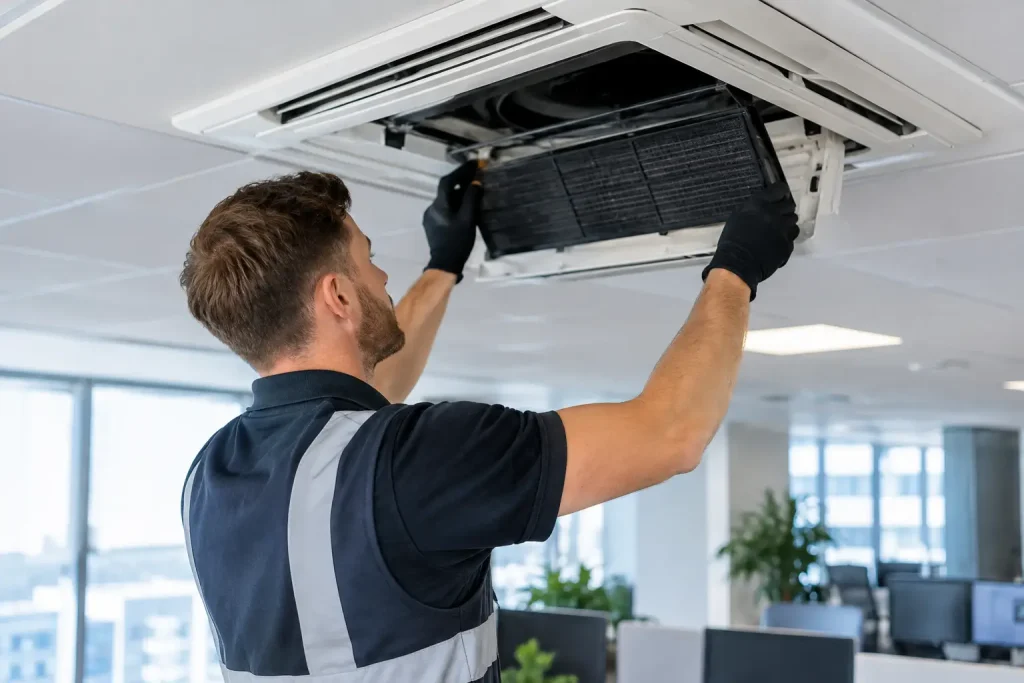
For indoor equipment, this normally includes checking filter condition, evaporator coil cleanliness, fan operation, airflow, temperature performance, electrical connections and the condensate tray and drainage route. Drainage needs careful attention. Algae, debris, poor pipe falls or failing condensate pumps can lead to ceiling leaks, damaged finishes and avoidable guest or tenant complaints.
Outdoor units require inspection of condenser coils, fans, electrical components, general condition and clear airflow around the equipment. Restricted coils or poor air movement can affect heat rejection and make a system work harder in warm weather. Engineers should also review controls, set points and obvious operating anomalies rather than assuming a comfort complaint is solely a refrigeration issue.
For ducted systems, access is part of the maintenance assessment. If filters or fan coil units cannot be reached without disrupting ceilings, furniture or occupied rooms, servicing may be skipped or rushed. That is not a sustainable arrangement. A good PPM plan identifies access limitations and recommends proportionate improvements, such as suitable access panels or a revised maintenance sequence.
Where applicable, refrigerant-related checks and records should be managed in line with current legal and equipment requirements. The exact obligations depend on the installation and refrigerant charge, so a maintenance provider should assess the individual system rather than making assumptions from its age or size.
Why Reactive Maintenance Costs More Than the Call-Out
Reactive maintenance often looks cheaper until a fault occurs at the wrong time. An office may cope with a failed unit on a mild day, but not during a heatwave when meeting rooms are full. A hotel may have to move guests, take rooms out of use or deal with complaints if a bedroom system fails during a busy period.
Planned maintenance cannot prevent every breakdown. Components can fail without warning, refrigerant leaks can develop and ageing systems eventually need repair or replacement decisions. What PPM can do is reduce avoidable failures and provide earlier visibility of emerging risks.
For example, a hypothetical office with several ceiling cassettes may report that one meeting room never feels as cool as the rest of the floor. A proper visit might find restricted airflow from a loaded filter, a dirty coil, incorrect controller settings, or a drainage issue causing the unit to stop intermittently. Treating the complaint as a one-off reset may restore operation briefly, but it does not establish the cause.
The same applies to repeated breakdowns. If a particular indoor unit repeatedly leaks, trips or performs poorly, the maintenance record should help identify whether the problem is access, drainage design, contamination, controls, refrigerant performance or equipment condition. Clear findings allow a facilities manager to approve targeted work with more confidence.
Planning PPM Around an Occupied Building
The best maintenance schedule fits the way the premises actually operates. Offices may prefer work outside core meeting times, while hotels may need maintenance coordinated around occupancy and room access. For larger systems, it is often better to service equipment in planned zones rather than create unnecessary disruption across the site.
A maintenance proposal should state what equipment is included, how often it will be visited, what checks are expected, and how findings will be reported. Ask whether the provider will inspect drainage, coils, controls and access arrangements, not just filters. It should also be clear how faults outside the planned visit are handled and how repair recommendations will be separated from routine maintenance work.
Good records matter. Asset lists, service dates, faults found, work completed and recommendations for the next visit create a useful operating history. This is especially valuable when managing agents inherit a building with unclear maintenance records, or when a business is deciding whether an ageing system is still sensible to repair.
When Servicing Should Lead to Repair or Replacement Planning
Maintenance should not keep an uneconomic system running indefinitely. If repairs are becoming frequent, room temperatures remain uneven despite corrective work, parts are difficult to obtain, or several units have reached a similar age, it may be time to review the asset plan.
That does not automatically mean replacement is the only answer. A targeted repair, drainage improvement, control adjustment or access modification may be the proportionate route. The decision should be based on the fault history, system performance, likely repair scope and operational impact, rather than a generic recommendation.
For commercial sites across Nuneaton, Coventry, Birmingham and the wider Midlands, OptimPRO can assess existing air conditioning systems and prepare a tailored PPM proposal around the building, its occupancy and the equipment in place. A planned maintenance discussion is often the practical first step towards fewer avoidable disruptions and clearer decisions when equipment needs attention.