
Best Air Conditioning Maintenance Schedule
A failed air conditioning unit rarely becomes a serious business issue at a convenient time. It happens during a heatwave, before a client visit, in a server room, or when staff and customers are already uncomfortable. The best air conditioning maintenance schedule is designed to prevent that scenario by matching servicing activity to how hard the system works, the environment it serves and its compliance obligations.
For a small office with one split system, a planned annual visit may be sufficient. For a busy restaurant, retail site, warehouse, medical setting or data centre, the right programme will usually involve more frequent inspections and a faster response arrangement. The objective is the same: protect uptime, control running costs and keep accurate evidence that your equipment is being managed properly.
What a good maintenance schedule needs to achieve
Air conditioning maintenance is not simply a filter clean. A properly structured programme looks at the condition, performance and legal status of the whole system. It should identify developing faults before they lead to lost cooling or heating, high energy use, water leaks or component failure.
For commercial operators, maintenance also supports predictable budgeting. Small defects such as a blocked condensate drain, worn fan bearing, loose electrical connection or refrigerant leak can become expensive repairs when they are left through a busy season. Planned work allows repairs to be scheduled around trading hours, occupancy and site access rather than carried out under pressure.
A suitable schedule should also support manufacturer warranty conditions. Many manufacturers require regular professional servicing, with service records available if a warranty claim is made. Without this evidence, an otherwise valid claim may be more difficult to progress.
The frequency of maintenance depends on system age, operating hours, occupancy, air quality and the consequences of failure. A unit running only during weekday office hours needs a different approach from equipment cooling a comms room around the clock.
Best air conditioning maintenance schedule by frequency
For most commercial systems, a twice-yearly planned preventive maintenance programme is the practical starting point. One visit should take place before the cooling season, typically in spring, and the second before heavier heating use in autumn for systems that also provide heat. This approach gives an engineer the opportunity to correct issues before the periods of greatest demand.
Annual servicing can be appropriate for low-use domestic systems and lightly used small commercial installations. However, annual maintenance is often a minimum rather than the best option for business-critical or high-use equipment. A system may appear to run normally while losing efficiency, accumulating debris or operating with components under unnecessary strain.
Quarterly inspections are often sensible for demanding sites, including restaurants, commercial kitchens, gyms, salons, manufacturing areas, server rooms and premises near busy roads or construction activity. Dust, grease, airborne contaminants and extended operating hours all increase the maintenance burden.
A typical maintenance programme can be structured around four levels of attention:
- Monthly on-site checks by a trained member of staff, focused on visible damage, unusual noise, airflow concerns, leaks, controller warnings and clear access around indoor and outdoor units.
- Seasonal professional servicing before peak cooling and heating demand, including cleaning, performance checks and mechanical and electrical inspection.
- Periodic F-Gas compliance checks, where required, based on the refrigerant type and charge within the equipment.
- Condition-based repairs and lifecycle planning, using service findings to replace vulnerable parts before they affect business continuity.
These activities do not replace one another. They work together. Day-to-day observation catches obvious changes quickly, while qualified maintenance identifies the issues that are not visible to building users.
Spring: prepare for cooling demand
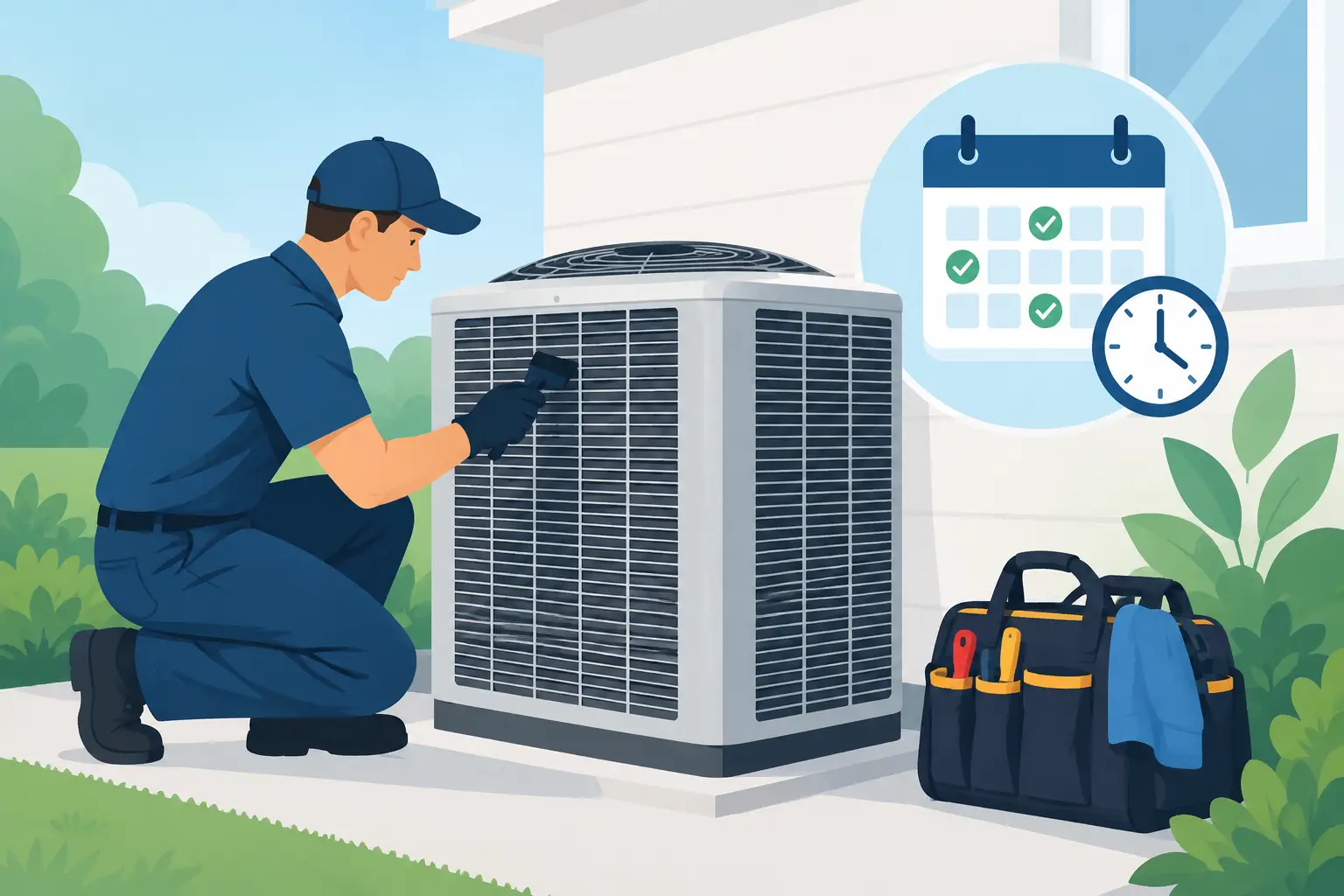
Spring servicing should focus on whether the system can provide reliable cooling when outdoor temperatures rise. Indoor and outdoor coils need inspection and cleaning where necessary, because dirt restricts heat transfer and forces compressors and fans to work harder. Filters should be cleaned or replaced according to their condition and the manufacturer’s requirements.
The engineer should check refrigerant circuit performance, operating pressures, temperatures, electrical connections, condensate drainage, fan operation and controls. Drainage is particularly important. A partially blocked condensate line may not cause a problem until humid conditions create more moisture, at which point water damage or a shut-down can follow.
For premises with multiple units, spring is also a good time to review whether each zone is being used as intended. Changes in layout, occupancy or equipment heat load can leave controls poorly set for the space.
Summer: monitor performance and respond early
During the busiest cooling period, facilities teams should pay attention to changes in comfort, runtime and noise. A unit that takes longer to cool, freezes up, trips intermittently or produces an unusual smell needs investigation before the fault escalates.
This is not necessarily the point for a full additional service at every site, but high-use and critical environments benefit from a mid-season check. In a data room, for example, reduced cooling capacity is an operational risk rather than a comfort issue. The cost of proactive attendance is generally far lower than the cost of equipment overheating or emergency downtime.
Autumn: protect heating performance and drainage
Many modern air conditioning systems are heat pumps, providing efficient heating as well as cooling. Autumn maintenance confirms that reversing valves, defrost controls, condensate management and outdoor units are ready for colder, wetter conditions.
Outdoor units deserve particular attention at this point. Leaves, litter and vegetation can obstruct airflow, while poor drainage around the base can create avoidable issues. The system should also be checked for secure mounting, damaged insulation and signs of corrosion.
Winter: review, record and plan ahead
Winter offers a useful opportunity to review service records and recurring faults. If a particular unit repeatedly requires call-outs, has declining performance or relies on obsolete parts, it may be time to plan a repair strategy or replacement before it becomes urgent.
For multi-site operators, this review should compare fault history, maintenance spend and asset age across the estate. It helps separate units that need routine care from those approaching the point where continued repair is no longer cost-effective.
Compliance is part of the maintenance programme
Businesses responsible for air conditioning equipment must consider F-Gas requirements alongside routine servicing. Leak checks may be legally required for systems above relevant refrigerant charge thresholds, with the required frequency determined by the amount of refrigerant expressed in tonnes of CO2 equivalent and whether leak detection is fitted.
The correct approach is not to assume every system has the same obligation. A qualified F-Gas engineer should identify the equipment covered, assess the applicable requirements and maintain the records needed for your site. These records should include refrigerant additions or recovery, leak test information, repairs and engineer details where relevant.
Compliance documentation matters when there is an inspection, an incident, a property handover or a warranty query. It also gives facilities managers a clearer record of asset condition and makes it easier to budget for planned work. Informal or missing paperwork can create uncertainty at exactly the point a business needs confidence.
What engineers should check at each planned visit
The scope of a service should reflect the installation, but a professional visit normally covers more than a visual inspection. The engineer should inspect filters, coils, fans, motors, electrical terminals, isolators, pipework insulation, drains, condensate pumps, controls and visible refrigerant components.
Operational testing is equally important. This may include checking supply and return air temperatures, airflow, compressor operation, current draw, fault history and the response of thermostats or control systems. The aim is to establish whether the equipment is operating efficiently, not merely whether it switches on.
Cleaning should be targeted rather than cosmetic. Over-cleaning delicate coils or using unsuitable chemical products can cause damage, while inadequate cleaning leaves the system inefficient. The right method depends on the equipment, location and level of contamination.
A useful service report should state what was inspected, what work was completed, any defects found and the recommended next actions. For decision-makers, the value is in clear priorities: what requires immediate attention, what should be budgeted for, and what can be monitored safely until the next visit.
Adjust the schedule to the risk of downtime
The best maintenance programme is risk-based, not one-size-fits-all. A wall-mounted unit in a small meeting room can tolerate a different level of risk from a system serving a retail floor, production space or critical IT environment.
Consider the cost of a failure. Would it affect staff wellbeing, customer experience, stock, regulatory conditions, sensitive equipment or revenue? Consider the operating pattern too. Extended hours, high occupancy, dirty environments and frequent door opening all increase workload and can justify more regular maintenance.
Age is another factor, but it should not be treated in isolation. A well-maintained older system may remain dependable, while a newer installation with neglected filters, drainage or controls can become inefficient quickly. Service history and measured performance provide a better basis for decisions than age alone.
Turn servicing into a planned asset strategy
A maintenance contract should give you more than booked visits. It should provide a clear service calendar, documented compliance support, transparent reporting and a route to responsive repairs when needed. For Midlands businesses, Optim PRO can tailor planned maintenance around site risk, system type and operational hours, whether you manage one property or a wider estate.
Start with an accurate asset list and a review of how each area is used. From there, the maintenance schedule becomes a practical tool for protecting comfort, compliance and continuity – rather than a task that only receives attention after a unit stops working.