
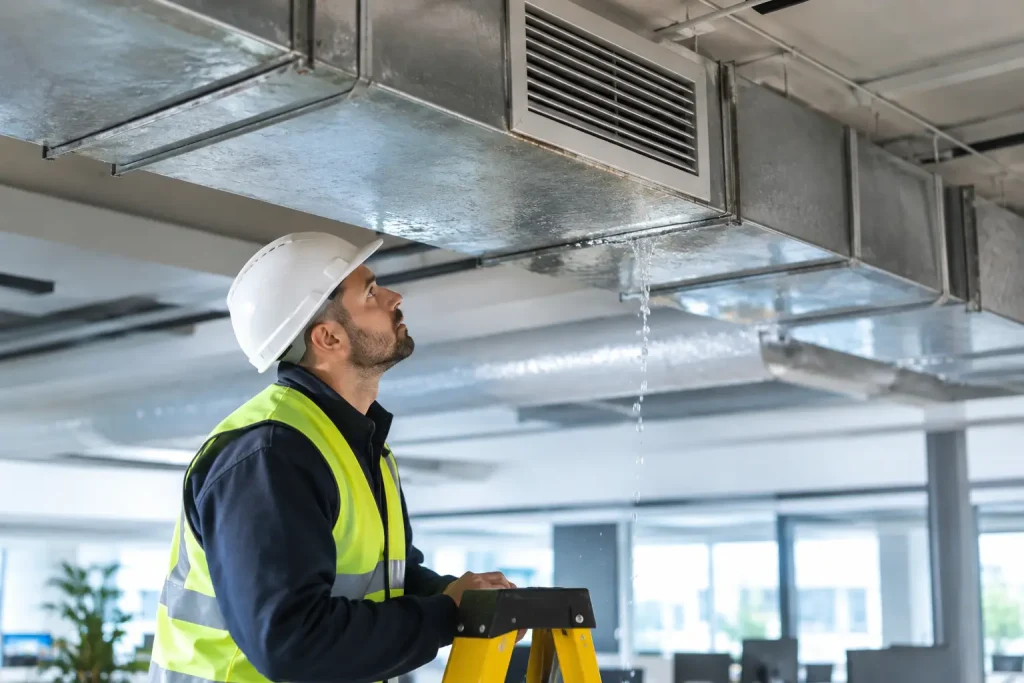
A water mark spreading across a suspended ceiling is rarely just a cosmetic problem. When people ask why ducted aircon leaks, they usually mean water is appearing from a grille, ceiling void or indoor unit at the worst possible time: during a busy office day, before a client meeting, or when hotel rooms are occupied. The visible drip may be small, but the cause can involve drainage, airflow, insulation, controls or poor maintenance access.
For facilities managers, the priority is not simply stopping the water for the day. It is understanding why it happened, what else may be affected, and how to reduce the risk of another disruptive call-out. Concealed ducted systems need a more thorough approach than a quick filter clean because much of the equipment, pipework and condensate drainage is hidden above ceilings.
Why ducted aircon leaks: water has to go somewhere
An air conditioning indoor unit removes heat from the air, and it also removes moisture. That moisture collects on the evaporator coil and runs into a condensate tray. From there, it should flow through correctly installed drain pipework to a suitable discharge point, or be lifted by a condensate pump where gravity drainage is not possible.
If that route is restricted, incorrectly arranged or poorly maintained, the tray can overflow. Water then finds the easiest path out, which may be through a ceiling grille, a light fitting, a ceiling tile or a joint in the ductwork. In an office, this can mean a meeting room is suddenly unusable. In a hotel, it can lead to guest complaints, room moves and damage to finishes.
Not every apparent air conditioning leak is condensate. A plumbing leak above a ceiling, rainwater ingress or a leaking chilled-water system can be mistaken for an air conditioning fault. A proper inspection should confirm the source before repairs are recommended.
The most common causes of ducted air conditioning leaks
Blocked or contaminated condensate drains
This is one of the most frequent causes. Dust, airborne debris and biological growth can build up in condensate trays and drain lines. Over time, the bore of the pipe narrows or becomes blocked completely. Water backs up into the tray until it overflows.
This is particularly common where a ducted unit has had irregular servicing, where filters have been left beyond their intended condition, or where the drainage route has long horizontal sections. Clearing the visible blockage may restore drainage, but the engineer should also examine the tray, pipework condition, fall and discharge point. Otherwise, the same fault can return.
Incorrect drain falls, traps or pipework alterations
Condensate pipework relies on sensible design as well as cleanliness. A gravity drain needs an adequate, continuous fall. If pipework has sagged, been altered during a fit-out, or contains sections that rise and fall, water can sit in the line rather than drain away.
Some ducted systems operate with negative pressure at the condensate connection. In these cases, the drain arrangement may need a correctly sized trap. Without it, air can be drawn into the drain line and prevent water leaving the tray properly. Equally, a poorly designed trap can hold debris and create repeat blockages.
This is why recurrent leaks need investigation rather than repeated emergency clearing. The underlying installation may be contributing to the fault.
Condensate pump failure
Where the drain cannot run downhill to a suitable outlet, a condensate pump is used to remove water. Pumps have moving parts, electrical connections, sensors and discharge pipework, so they need checking as part of planned maintenance.
A failed pump may stop running, run intermittently or fail to trigger when the water level rises. A blocked pump reservoir or discharge line can produce much the same result. In a concealed installation, the first sign may be water staining below the unit rather than an obvious alarm.
Dirty filters and restricted airflow
A neglected filter does more than reduce indoor air quality. It restricts airflow across the evaporator coil. With insufficient air passing over the coil, its temperature can fall too low and the coil may freeze.
When the system cycles off or the ice melts, a larger-than-normal volume of water reaches the tray at once. If the tray or drain is already marginal, it can overflow. Restricted airflow may also cause uneven room temperatures, weak supply air and longer running times, all of which matter in occupied offices and guest areas.
Filters should therefore be assessed in context. An engineer should consider their condition, the condition of the coil, fan operation, duct airflow and whether the maintenance interval still suits how the building is used.
Frozen coils caused by refrigeration or control faults
Dirty filters are not the only reason a coil freezes. Low refrigerant charge, an expansion device issue, a faulty fan, incorrect control settings or a sensor problem can all affect coil temperature and performance.
These faults require diagnosis rather than assumption. Refrigerant circuit work must be carried out by appropriately qualified personnel, but the starting point is often a broader inspection of system operation. Replacing a pump or flushing a drain will not resolve a leak that is actually being driven by repeated coil freeze-thaw cycles.
Damaged condensate trays and poor access
Older units can develop damaged, distorted or corroded condensate trays. Cracks may only leak when the unit is operating at high load, making the problem difficult to identify during a short visit. Drain connections can also loosen, particularly where pipework has been disturbed above a ceiling.
Access is a practical issue that is often overlooked. If there is no safe and adequate route to the fan coil unit, tray, filters and drain connection, proper inspection becomes difficult. A maintenance plan should identify inaccessible equipment and recommend proportionate improvements, such as access panels, before a minor issue becomes a ceiling repair.
Condensation on uninsulated ducts or pipework
Sometimes the leak is not from the unit’s condensate tray at all. Cold ductwork or refrigerant pipework can sweat when insulation is missing, damaged or poorly sealed. Warm, humid air reaches the cold surface, moisture forms and water drips into the ceiling void.
This tends to be more noticeable during humid weather or where ceiling void ventilation is limited. The remedy may involve repairing insulation and vapour seals, rather than altering the condensate system. Identifying the precise location of moisture is essential before any corrective work is approved.
What a useful maintenance visit should examine
For concealed ducted air conditioning, a credible service visit should look beyond filters. The engineer needs to check filter condition and fit, coil cleanliness, fan operation, condensate tray condition, drain flow, pump operation where present, pipe insulation, electrical connections and controls. Where performance concerns are reported, airflow and temperature behaviour should also be considered.
The scope should reflect the system and its use. A lightly used office suite may need a different maintenance frequency from a hotel with systems running across long occupancy hours. Seasonal use, occupancy patterns, local dust levels, kitchen-adjacent areas and previous drainage faults can all influence the right programme.
Maintenance cannot prevent every failure. Pumps can fail without warning, building alterations can affect drainage, and ageing components eventually need repair or replacement. However, regular inspection can identify developing issues such as slow drains, dirty coils, damaged insulation and declining airflow before they become a leak into an occupied space.
Responding to a leak without creating a bigger problem
If water is coming through a ceiling, the immediate concern is safety and limiting damage. Keep occupants away from the affected area, especially if water is near lighting, electrical equipment or ceiling fittings. If it is safe to do so, stop the affected air conditioning unit and arrange assessment.
Avoid treating repeated leaks as a housekeeping issue. Replacing stained tiles without investigating the source can conceal a developing fault. It also makes it harder to establish whether the water came from condensate, pipework, roof ingress or another building service.
A useful fault report should state what was found, what was tested, the likely cause, corrective action taken and any further work recommended. This helps property managers build a service history and decide whether a one-off repair is sufficient or whether wider maintenance attention is needed.
When repair planning should become replacement planning
A single blocked drain does not normally justify replacing a ducted system. Repeated leaks, persistent coil faults, deteriorated trays, inaccessible equipment and a growing pattern of call-outs may be different. The decision depends on age, condition, repair history, parts availability, operating performance and the disruption caused by keeping the system in service.
For example, a hypothetical hotel may have one concealed fan coil repeatedly leaking into the same corridor ceiling. If drainage has been cleared several times but the tray is corroded and access requires repeated disruption to finishes, planned replacement during a quieter period may be more manageable than another reactive repair. The right choice should be based on evidence, not simply the age of the unit.
For offices and hotels across the Midlands, OptimPRO can assess the complete ducted installation, explain the cause of recurring leaks and develop a tailored planned preventative maintenance proposal around the building’s equipment and occupancy. Discuss your systems and arrange a maintenance assessment to help reduce avoidable disruption and make equipment care easier to budget for.