

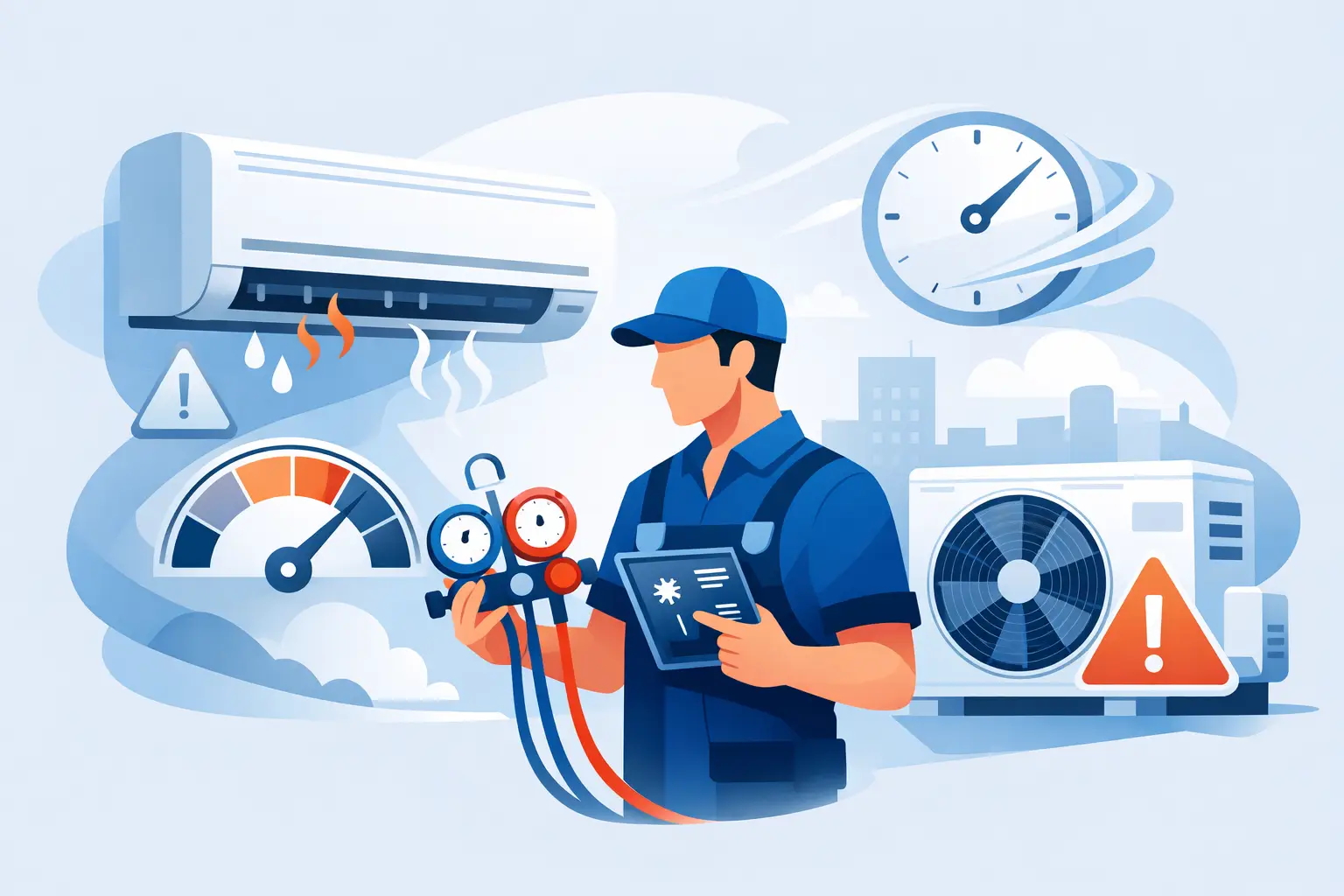
Urgent Aircon Fault Diagnosis for Fast Recovery
When an air conditioning system fails at 10am on a trading day, the issue is rarely just temperature. Staff comfort drops, server rooms come under pressure, customers notice straight away, and any delay starts to carry a cost. That is why urgent aircon fault diagnosis matters – not as a generic repair visit, but as a fast, structured process that identifies the real cause of failure before the problem spreads.
For commercial sites, speed on its own is not enough. A quick reset might get cooling back for an hour, but if the underlying fault is low refrigerant charge, a failed sensor, a blocked coil, or an electrical component breaking down under load, the same unit will stop again. Proper diagnosis protects uptime, avoids repeat call-outs and gives decision-makers a clear basis for repair, replacement or short-term contingency planning.
What urgent aircon fault diagnosis should achieve
A good emergency response is not simply about attending site quickly. It should establish what has failed, how severe the fault is, whether the equipment can continue to run safely, and what action is required to restore stable performance.
That matters because air conditioning faults often present with similar symptoms. Poor cooling, unusual noise, icing, water leaks and intermittent shutdowns can all point to very different causes. Replacing parts too early wastes money. Delaying action where there is an electrical or refrigerant-related issue creates more risk. The value of urgent diagnosis is that it narrows the problem fast and turns a disruptive failure into a controlled maintenance decision.
On a commercial property, that decision also needs to consider compliance, asset age, occupancy levels and the operational importance of the affected area. A comfort cooling fault in a meeting room is not the same as a failure affecting a comms room, healthcare setting or food service area.
Common faults found during urgent aircon fault diagnosis
In practice, most urgent call-outs fall into a handful of categories, although the root cause can still vary from site to site. Electrical faults are common, especially on systems that have had irregular maintenance. Failed capacitors, contactor issues, damaged wiring and tripped protection devices can all stop a system from starting or force it into intermittent operation.
Refrigerant-related faults are another regular cause of breakdown. A leak, an undercharge or a pressure problem can reduce cooling output, cause coil icing and place extra strain on compressors. This is where certified handling and proper testing matter. A temporary top-up without leak investigation is not a sound repair strategy, and in many cases it can leave the site exposed to repeat failure and compliance concerns.
Airflow issues are also frequently misread as major system faults. Dirty filters, blocked coils, failed fan motors or obstructions around condensers can trigger high pressure alarms, poor performance and shutdowns. The symptom may look serious, but the right diagnosis can separate a maintenance issue from a major component failure.
Controls and sensors are another area where urgent faults often begin. A failed room sensor, communication error between indoor and outdoor units, or a control board issue can make a healthy system behave unpredictably. These faults are easy to misdiagnose if the engineer is only looking at the visible symptom rather than the wider operating data.
Why speed matters, but method matters more
There is a clear business case for rapid attendance. The longer a system stays down, the greater the impact on productivity, customer experience and equipment stress elsewhere in the building. Yet urgency should not lead to guesswork.
The best fault diagnosis follows a disciplined sequence. First comes the site context – what the system serves, when the issue started, whether the fault is total or intermittent, and whether any recent work or power disruption took place. Then comes testing: operating pressures, temperatures, electrical readings, control logic, airflow and condensate behaviour. Only after that should repair recommendations be made.
This approach avoids one of the most expensive patterns in HVAC breakdown response: replacing the obvious failed part without identifying why it failed in the first place. A burnt contactor may be the result of another issue. An iced evaporator may be the symptom rather than the cause. Good diagnosis reduces repeat disruption because it treats failure as a system event, not just a single broken component.
Urgent aircon fault diagnosis in commercial environments
Commercial systems rarely fail at a convenient time, and the consequences differ by sector. In offices, discomfort can quickly become a staff welfare issue, especially in glazed buildings or upper-floor spaces. In retail and hospitality, poor temperature control affects customer dwell time and trading conditions. In industrial or technical settings, a cooling fault can threaten equipment reliability or process stability.
That is why commercial clients usually need more than a repair note. They need a clear explanation of the fault, any short-term operating risks, likely repair timescales, and whether temporary mitigation is possible. They may also need service records to support internal reporting, landlord responsibilities or maintenance planning across multiple sites.
For facilities teams and property managers, this is where an engineering partner adds value. Diagnosis should be translated into operational terms: can the area remain occupied, is there a compliance consideration, will this affect warranty position, and is repair economically sensible given the age and condition of the system?
When a breakdown points to a wider maintenance problem
An emergency failure is often the first visible sign of a longer-term servicing gap. Dirty heat exchangers, loose electrical terminations, refrigerant loss, blocked drains and control calibration problems usually build over time. They do not always stop the unit immediately, but they reduce efficiency and increase the likelihood of a sudden shutdown when demand rises.
That is one reason planned preventive maintenance remains important even when the immediate concern is urgent attendance. Regular servicing lowers the chance of surprise failures, but it also improves the quality of emergency response because there is already a service history, a record of previous readings and a clearer picture of component condition.
For businesses managing ageing HVAC assets, fault diagnosis can also help with budgeting. A single repair may be the right move, but repeated emergency failures on the same system often point to a different decision. Sometimes the lowest-cost option this month creates the highest operating cost over the next year.
What to do before the engineer arrives
There are a few sensible checks a site team can make without interfering with the system. Confirm whether the issue affects one unit or a wider area, note any fault codes showing on controllers, and identify whether there has been a recent power interruption or change to building controls. If there is water leakage, isolate the affected area to reduce slip risk. If a critical space is overheating, start any contingency process early rather than waiting for temperatures to rise further.
What should not happen is repeated resetting by untrained staff. A reset can clear a fault temporarily, but it can also mask the pattern the engineer needs to see. In the case of electrical or compressor-related issues, repeated restarts may make the damage worse.
Choosing the right response partner
Urgent aircon fault diagnosis is not just about who can get to site first. It is about who can diagnose accurately, work safely, handle refrigerant and electrical issues correctly, and provide a realistic plan from first attendance. For Midlands businesses, that means looking for a provider with commercial experience, F-Gas certification, and the ability to support both immediate recovery and longer-term maintenance strategy.
Optim PRO works in that space because many clients do not need a one-off fix in isolation. They need a dependable service partner who understands downtime, compliance pressure and the financial effect of recurring HVAC failures across occupied buildings.
The strongest outcomes usually come from treating urgent diagnosis as the start of a better maintenance decision, not the end of the problem. When the fault is identified properly, the next step becomes clearer – repair, targeted remedial work, closer monitoring or a servicing plan that prevents the same disruption returning next season.
If your system has failed, the main priority is not just getting cold air back for the afternoon. It is restoring reliable performance in a way that protects the building, the budget and the asset over time.