

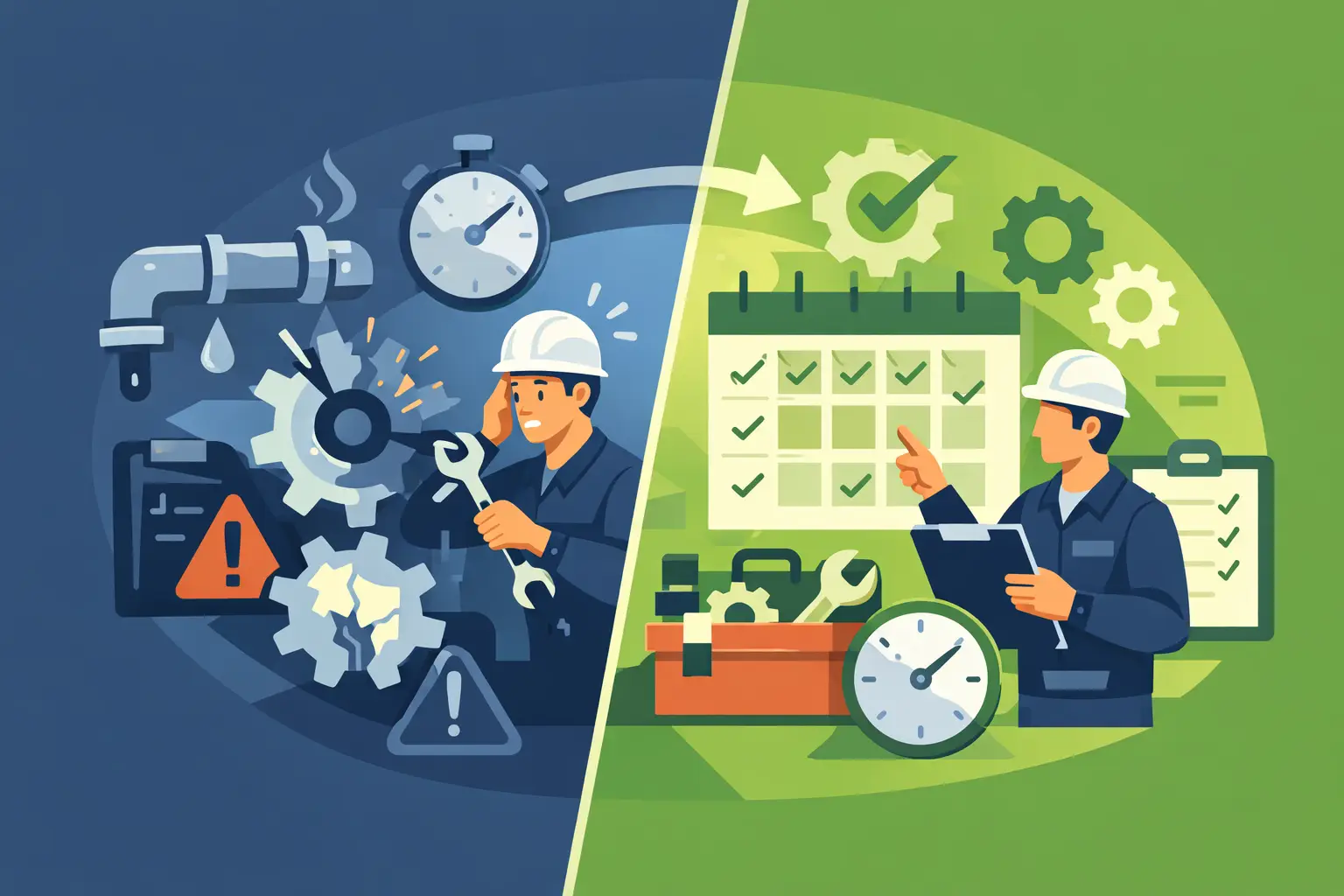
Reactive vs Planned Maintenance Explained
A comfort cooling failure at 2pm in a busy office, restaurant or server room rarely stays an engineering issue for long. It becomes a business continuity problem. That is why reactive vs planned maintenance is not simply a technical choice. It affects downtime, repair spend, compliance, energy use and how much control you have over your building services.
For commercial air conditioning and ventilation systems, the difference is straightforward. Reactive maintenance means you deal with faults after something has already gone wrong. Planned maintenance means the system is inspected, serviced and tested at scheduled intervals to reduce the chance of failure. Both approaches have a place, but they do not carry the same level of risk.
What reactive vs planned maintenance really means
Reactive maintenance is often described as a break-fix approach. The unit stops cooling, starts leaking, trips out, shows a fault code or performs poorly, and only then is an engineer called. For some non-critical assets, that may seem efficient. You avoid regular service costs and spend money only when a problem appears.
The difficulty is that HVAC faults rarely arrive at a convenient time. A failed fan motor in summer, a blocked drain in a customer-facing space, or refrigerant loss in a critical environment can disrupt operations quickly. The visible repair is only part of the cost. Lost productivity, uncomfortable occupants, damaged stock, emergency call-out charges and pressure on internal teams all add up.
Planned maintenance works differently. Service visits are scheduled around the needs of the site and the duty of the equipment. Engineers inspect components, clean key parts, check refrigerant circuit performance, test controls, review electrical connections and record condition before minor issues become major failures. The aim is not to claim that breakdowns will never happen. It is to make them less likely, less severe and less expensive.
Why planned maintenance is usually the stronger commercial choice
For most businesses, air conditioning is no longer a nice-to-have. It supports staff comfort, server stability, customer experience, product protection and indoor air quality. In many settings, poor system performance directly affects revenue and risk.
A planned regime gives you far better visibility over asset condition. Instead of waiting for a complaint from occupants or a full failure on site, you have a clearer picture of how the system is operating and where wear is developing. That makes budgeting more predictable. It also allows maintenance to be scheduled at lower-impact times rather than during a live fault when speed matters more than cost efficiency.
There is also the energy question. A neglected HVAC system often keeps running while quietly becoming less efficient. Dirty coils, blocked filters, failing capacitors and drifting controls can increase energy consumption long before the plant stops altogether. Reactive maintenance may restore operation after failure, but it does little to prevent that period of underperformance beforehand.
For commercial property operators, another point matters just as much: compliance and documentation. Air conditioning systems can carry legal and manufacturer obligations around inspection, refrigerant handling, servicing records and warranty conditions. A purely reactive model can leave gaps in service history and create unnecessary exposure when audits, claims or landlord responsibilities come into focus.
Where reactive maintenance still has a place
That does not mean reactive maintenance is always wrong. It depends on the type of asset, the environment and the cost of failure.
If a system is old, non-critical and close to planned replacement, some operators may decide against a full maintenance programme and manage faults as they arise. The same may apply to low-use equipment in secondary spaces where short downtime creates limited disruption. In these cases, a reactive strategy can make commercial sense, provided the decision is deliberate rather than accidental.
The problem comes when businesses treat essential cooling, ventilation or heat recovery systems the same way. If the space depends on stable temperatures, continuous occupancy, sensitive equipment or customer comfort, a reactive-only approach usually shifts too much cost into downtime and emergency response.
Reactive vs planned maintenance for HVAC systems
HVAC plant is particularly poorly suited to a wait-until-it-breaks model because many faults build gradually. Filters load up over time. Condensers become dirty. Drainage issues develop slowly. Electrical components weaken before they fail. Refrigerant-related problems can reduce efficiency and capacity before anyone realises there is a significant issue.
Planned maintenance is effective because it targets those early warning signs. A routine visit can identify abnormal pressures, worn belts, loose terminals, airflow restriction or poor temperature differential while the system is still running. That gives you options. You can plan remedial work, coordinate access, manage spend and avoid a larger operational interruption.
This is especially relevant for multi-site businesses, hospitality venues, retail units, offices and critical rooms where environment control supports day-to-day trading. In those settings, one avoidable failure can affect far more than a single item of plant.
Cost is not just the invoice total
One reason some businesses delay planned maintenance is the belief that reactive maintenance is cheaper. On paper, that can look true for a short period. If you do not book scheduled services, there is no routine maintenance invoice to approve.
But asset strategy should be judged on total cost, not just visible service cost. Emergency attendance, parts failure, shortened plant life, excess energy use and repeated disruption can easily outweigh what a structured maintenance plan would have cost. Planned maintenance also helps identify when repair is no longer economical, which prevents money being repeatedly spent on ageing equipment with declining reliability.
There is a wider budget benefit as well. Planned service spreads costs more evenly through the year and reduces the number of surprise failures competing with other operational priorities. For facilities and operations teams, that kind of predictability has real value.
The compliance and warranty factor
Many businesses only think about compliance after a problem surfaces. That is risky. HVAC systems are not just mechanical assets. They can carry obligations linked to refrigerants, inspections, service records and safe operation. If documentation is poor, a simple maintenance issue can become a legal or contractual concern.
Manufacturer warranties can also be affected by missed servicing. If a system has not been maintained in line with requirements, a claim may not be as straightforward as expected. Planned maintenance supports both performance and proof. It creates a documented service history that helps demonstrate that the equipment has been looked after correctly.
For landlords, managing agents and businesses with formal health and safety responsibilities, that paper trail is not an administrative extra. It is part of responsible asset management.
How to decide which approach fits your site
The right strategy depends on consequence. Start by asking what happens if the system fails. If the answer is lost trade, staff discomfort, compliance concerns, damage to equipment, tenant complaints or interruption to critical operations, planned maintenance should be the default position.
Then consider the age and complexity of the system. Newer equipment still needs servicing to protect efficiency and warranty conditions. Older systems often need it even more because components are approaching higher-risk stages of wear. Site type matters too. A small back-office split system does not carry the same operational weight as cooling serving a comms room, medical area or busy hospitality environment.
A sensible maintenance plan should reflect those differences. Not every site needs the same visit frequency or service level. The strongest approach is one that matches the asset criticality, occupancy pattern and business risk rather than applying a generic standard everywhere.
A balanced strategy often works best
In practice, many organisations do not choose between reactive and planned maintenance in absolute terms. They use planned maintenance as the foundation and reactive support for unexpected faults that still occur. That is usually the most realistic model.
Even well-maintained systems can fail because no asset lasts forever and some parts simply reach end of life. The value of planned maintenance is that it reduces the odds of sudden breakdown, improves response planning and makes those reactive events less frequent and easier to manage.
For businesses across the Midlands, that balance often delivers the strongest operational result: scheduled servicing to protect performance and compliance, backed by dependable repair support when something unplanned happens. That is the basis on which many commercial clients work with Optim PRO, particularly where uptime and documented maintenance matter as much as the repair itself.
The most useful question is not whether you can afford planned maintenance. It is whether your site can comfortably absorb the cost and disruption of avoidable failure. If the answer is no, the case for a structured maintenance programme is usually already made.