
Top Aircon Faults in Office Buildings and Fixes
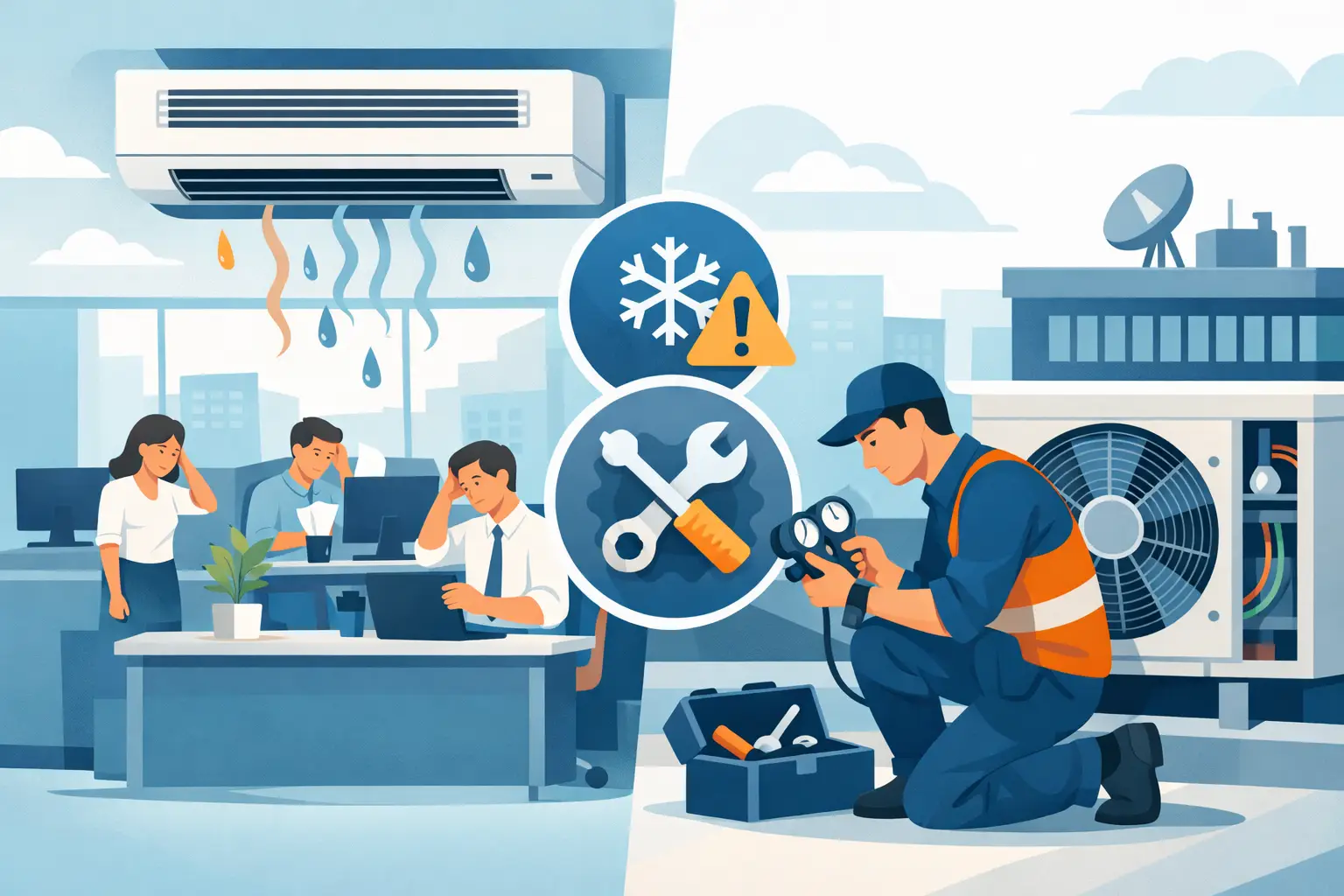
A meeting room that is too warm at 10am, water dripping through a ceiling tile, or an outdoor unit that suddenly stops are not minor facilities issues. The top aircon faults in office buildings can disrupt staff productivity, affect customer-facing areas, raise energy use and leave a business exposed to avoidable repair costs. Most failures give warning signs before they become urgent, provided they are recognised and investigated early.
For office managers, landlords and facilities teams, the priority is not simply getting cooling back on. It is restoring reliable operation, identifying the underlying cause and ensuring the system remains compliant, efficient and supportable over the long term.
Why office air conditioning faults escalate
Office air conditioning is often expected to work quietly in the background for long hours, across changing occupancies and seasonal temperatures. Yet filters become blocked, drains collect debris, electrical components wear and refrigerant circuits can develop leaks. When planned maintenance is missed, these small issues combine and place strain on the whole system.
A fault in one indoor unit may also point to a wider issue. For example, poor airflow could be caused by one neglected filter, but it may equally indicate fan failure, incorrect controls settings, a blocked coil or a system that is no longer correctly commissioned for the space. A proper diagnosis matters because a quick reset may restore cooling temporarily without protecting the asset.
Top aircon faults in office buildings
Poor cooling or uneven temperatures
This is one of the most common complaints in offices. One area may feel comfortable while another remains warm, particularly in meeting rooms, south-facing spaces, server rooms or zones with high equipment loads. Staff may respond by changing local controller settings repeatedly, which can make the wider problem harder to identify.
Restricted airflow is a frequent cause. Dirty filters and indoor coils prevent the system from moving enough air and reduce its ability to transfer heat. Other causes include low refrigerant charge, failing fans, incorrectly positioned temperature sensors, damaged ductwork in ducted systems, or controls that are not set up to reflect actual occupancy.
The business impact is greater than discomfort. A system running continuously to meet an unreachable set point uses more electricity and accelerates wear on compressors and fans. An engineer should check airflow, temperatures, refrigerant performance and controls rather than treating poor cooling as a simple thermostat issue.
Water leaks from indoor units
Water marks on ceiling tiles or dripping from a wall-mounted unit require prompt attention. During cooling, an indoor unit removes moisture from the air. That condensation should flow through a drain line to a suitable discharge point. If the pipe becomes blocked by dirt, algae or sludge, water can back up into the unit and overflow.
A damaged condensate pump, poor pipe fall, frozen evaporator coil or poorly insulated pipework can produce similar symptoms. The immediate concern is preventing damage to ceilings, furniture, IT equipment and electrical systems. The longer-term concern is finding why the drainage arrangement failed.
Clearing a blockage may be sufficient in a lightly used unit. However, recurring leaks often call for a review of drain routing, pump operation and cleaning frequency. In multi-tenanted buildings, it is also worth confirming responsibility for concealed pipework before a minor leak becomes a dispute or a costly reinstatement project.
Unusual noises and vibration
Rattling, buzzing, grinding or persistent clicking should not be ignored simply because the system is still cooling. Loose panels and pipework can create a basic rattle, but mechanical noise can also signal worn fan bearings, a failing motor, compressor problems or vibration transferred through brackets and building fabric.
Noise complaints matter in offices because they affect concentration and can indicate a component close to failure. A vibrating outdoor condenser may also disturb neighbouring occupiers, particularly where plant is located near roof terraces, loading areas or residential boundaries.
The right repair depends on the source. Securing pipework is very different from replacing a fan motor or investigating a compressor. Recording when the sound occurs – at start-up, only at high load, or continuously – gives the attending engineer useful diagnostic information and can reduce downtime.
Bad smells and declining indoor air quality
Musty, stale or unpleasant odours are often blamed on the air conditioning unit, although the source may be within the occupied space, ventilation system or drainage arrangement. Within an air conditioning system, dirty filters, contaminated coils, standing water in drains and poor maintenance can all contribute to odours and reduced air quality.
For offices, this becomes a staff wellbeing and operational issue. Complaints may increase during busy periods when meeting rooms are fully occupied and windows remain closed. If the building relies on heat recovery ventilation alongside comfort cooling, both systems need to be assessed. Cooling equipment recirculates or conditions air, while ventilation provides the controlled fresh-air element required for a healthy internal environment.
Cleaning components without investigating airflow and drainage can provide only a short-lived improvement. A planned service should include filter condition, coil cleanliness, condensate management and a check that ventilation arrangements remain suitable for the building’s use.
Refrigerant leaks and low system pressure
Refrigerant does not get used up in normal operation. If a system needs repeated top-ups, it should be treated as evidence of a leak until proven otherwise. Low refrigerant levels reduce cooling capacity, can cause coils to ice up and force compressors to work harder. Left unresolved, the result may be a much more expensive component failure.
This fault also has a compliance dimension. Businesses operating equipment containing F-Gas refrigerants have responsibilities around leak checks, record keeping and repairs, depending on the refrigerant charge and carbon dioxide equivalent. Work on refrigerant circuits must be carried out by appropriately certified engineers, with documentation retained as part of the site maintenance record.
The practical approach is leak detection, repair, pressure testing where required, evacuation and recharge to the manufacturer’s specification. Adding refrigerant without finding the leak may restore cooling for a short period but does not protect compliance, operating costs or equipment life.
Electrical and controls failures
Many apparent air conditioning failures are electrical or controls-related. A unit may not start because of a failed capacitor, contactor, relay, printed circuit board, isolator, communication fault or local power supply issue. Building management system controls can also create problems when time schedules, temperature set points or interlocks are incorrectly configured.
These faults can be intermittent. A system may operate in the morning but trip during the afternoon when demand rises, or one indoor unit may show an error while the rest of the system appears normal. That makes diagnosis more involved than replacing a visible part.
A competent repair process checks safe electrical supply, fault codes, communications between indoor and outdoor equipment, controller settings and component condition. For larger offices, clear labelling of isolators and accurate plant records save valuable time during an urgent call-out.
Frozen coils and restricted airflow
Ice on refrigerant pipework or a frozen indoor coil is a clear sign that the system should be inspected. It may be caused by blocked filters, dirty coils, fan problems, low refrigerant charge or operation in unsuitable conditions. Continuing to run the unit can cause water leaks as it thaws and may place the compressor at risk.
Turning the unit off and allowing it to defrost may prevent immediate damage, but it is not a repair. The cause must be confirmed before returning the system to service. This is particularly important in comms rooms and other areas where cooling is business-critical and staff may be tempted to restart equipment repeatedly.
Outdoor unit damage and poor heat rejection
Outdoor condensers need adequate airflow to reject heat. Leaves, litter, vegetation, stored materials and accumulated dirt can restrict that airflow. In commercial locations, outdoor units can also suffer accidental damage, vandalism, corrosion or blocked coil fins.
When heat cannot escape efficiently, energy consumption rises and cooling performance falls. The system may then trip on high pressure during warm weather – exactly when the office needs it most. Seasonal cleaning, visual inspections and clear plant access are straightforward measures that reduce this risk.
Preventing faults without overspending
There is no single maintenance frequency that suits every office. A small, lightly occupied premises with a few split units has different needs from a multi-floor office with variable refrigerant flow systems, ventilation plant and critical IT cooling. Usage hours, location, dust levels, occupancy patterns, system age and manufacturer requirements should shape the service plan.
Planned preventive maintenance normally focuses on cleaning filters and coils, checking drains, inspecting electrical components, testing operating pressures and temperatures, reviewing controls, and recording any developing defects. It should also account for F-Gas obligations and warranty conditions. The objective is predictable performance and budgeting, not maintenance activity for its own sake.
Facilities teams should keep a simple record of faults, occupied areas affected, repeat call-outs and energy concerns. Patterns are often more revealing than a single breakdown. If the same meeting room overheats every month, or an outdoor unit trips whenever temperatures rise, the site needs a corrective solution rather than another temporary attendance.
Optim PRO supports Midlands businesses with tailored servicing, repairs and compliance-led maintenance for commercial air conditioning systems. A structured programme gives decision-makers clearer records, fewer surprise failures and a practical basis for planning repairs or replacement before a system becomes a business interruption.
When an air conditioning issue first appears, act while it is still a controlled maintenance task. Early investigation protects comfort today, but more importantly, it protects the continuity, efficiency and lifespan of the building systems your team relies on every working day.