
Retail Shop Air Conditioning Repair Guide
A warm shop floor changes customer behaviour faster than most retailers expect. Dwell time drops, staff become distracted, refrigerated areas work harder, and complaints start before the afternoon peak. When that happens, retail shop air conditioning repair stops being a maintenance issue and becomes an operational priority.
For retail operators, the question is rarely whether a fault needs attention. The real issue is how quickly it can be diagnosed, whether the repair is commercially sensible, and what can be done to reduce the chances of another failure next month. A reliable response matters, but so does understanding why the system failed in the first place.
Why retail environments need a different repair approach
Air conditioning in a retail setting carries a heavier business burden than many other commercial spaces. A shop relies on stable temperature control to support customer comfort, staff productivity and, in some cases, product quality. The impact is even greater in convenience retail, fashion, salons, pharmacies and stores with high footfall or strong solar gain through front glazing.
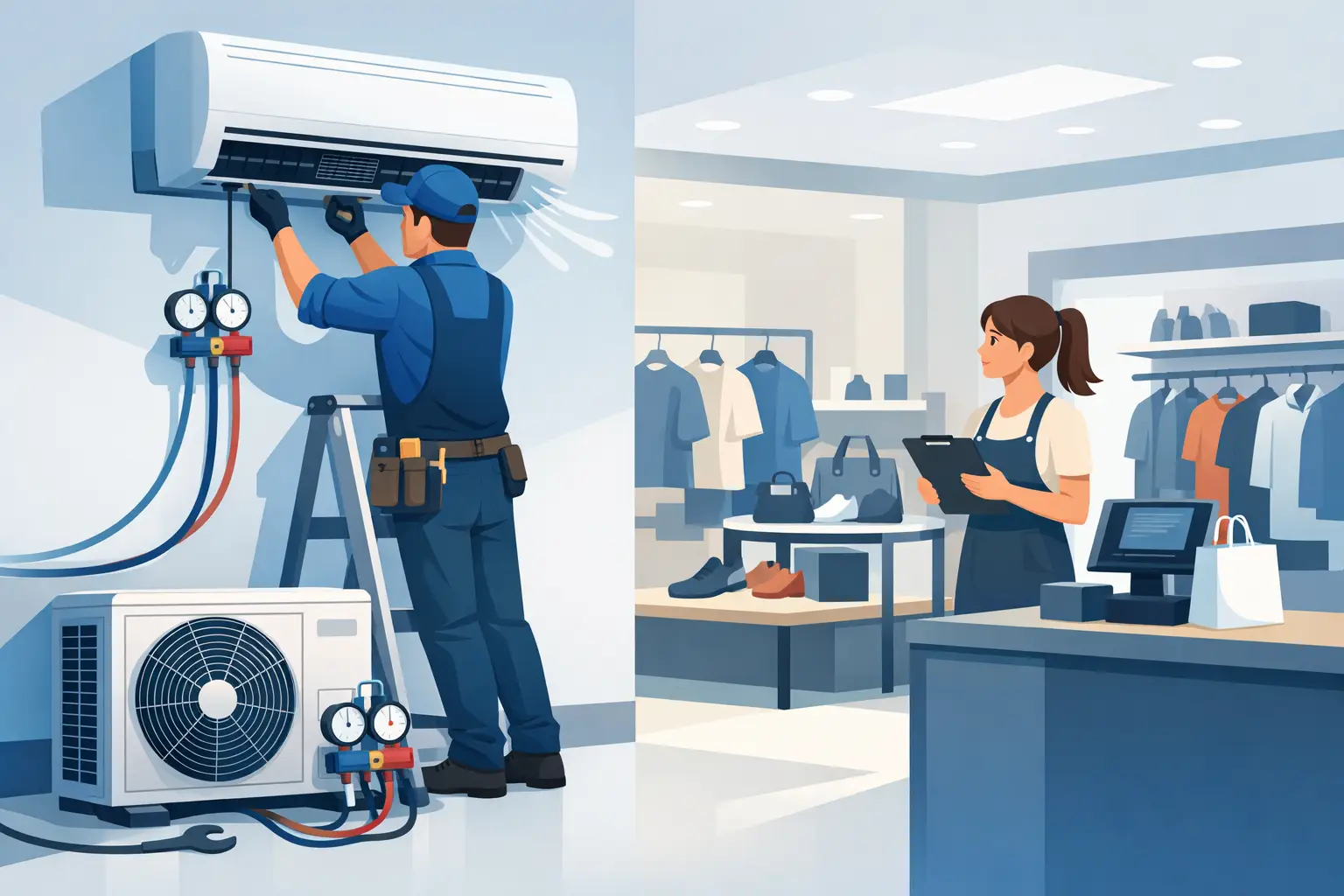
That means repair work has to be handled with the trading environment in mind. Engineers need to assess not only the equipment fault, but also the commercial effect of downtime, out-of-hours access requirements, and whether a temporary operational workaround is possible while parts are sourced. A back-office split system serving a small stockroom is one matter. A failed cassette unit above a busy sales area in midsummer is another.
This is why quick fixes are not always the right fixes. If a repeated issue points to poor airflow, blocked coils, refrigerant loss or electrical stress, simply resetting the unit may get it running for a day or two, but it does not protect trading continuity.
Common faults behind retail shop air conditioning repair
Most retail air conditioning failures begin with a small performance issue that goes unchecked. Reduced cooling, uneven temperatures, unusual noises and intermittent shut-downs are often early warning signs rather than isolated glitches.
A dirty filter is one of the simplest examples. It restricts airflow, forces the system to work harder and can lead to coil icing or poor temperature control. In a busy shop, that may show up first as a warm area near the entrance or fitting rooms rather than a complete breakdown.
Electrical faults are also common, particularly in ageing systems or sites where units run for long trading hours. Failed capacitors, worn contactors, control board issues and sensor faults can all interrupt operation. Some of these faults are straightforward to rectify. Others point to deeper wear across the system and need a broader assessment before repair spend is approved.
Refrigerant-related problems need careful handling. If a system is short of refrigerant, there is usually a leak that must be identified and resolved rather than simply topped up. That is not only best practice – it also has compliance implications, especially on equipment covered by F-Gas requirements.
Drainage issues can be just as disruptive. A blocked condensate line may trigger alarms, cause water ingress or force the unit to shut down to prevent internal damage. In a customer-facing environment, even a small leak from a ceiling cassette can quickly become a reputational problem.
What a proper repair visit should achieve
A worthwhile repair visit should do more than restore cooling. It should establish the root cause, confirm whether there has been any wider damage, and give the site contact a clear view of next steps.
That starts with diagnosis. Retailers should expect the engineer to check operating pressures, temperatures, electrical components, controls, filters, coils, drainage and general unit condition. If the system has failed repeatedly, the visit should also consider whether maintenance standards, usage patterns or site conditions are contributing to the issue.
From there, the decision becomes commercial. Sometimes the best option is an immediate repair with minimal disruption. Sometimes the repair is viable, but only if combined with remedial cleaning or follow-up servicing. And sometimes an older unit is approaching the point where repeated call-outs cost more than a planned replacement strategy.
Clear reporting matters here. Facilities teams and business owners need enough detail to make decisions with confidence, particularly across multi-site estates where HVAC spend must be justified and prioritised.
Repair or replace? It depends on the system and the site
Not every failed system should be replaced, and not every repair represents value. The right decision usually depends on five factors: system age, fault frequency, parts availability, energy performance and the operational importance of the area served.
If a relatively modern system has a contained fault and the core components remain in good condition, repair is often the sensible route. This is especially true where the equipment is correctly sized, supported by regular servicing and still within a useful stage of its lifecycle.
The position changes when faults become repetitive. A retailer paying for multiple reactive visits, temporary cooling measures and staff disruption may be carrying hidden costs that do not appear on the repair invoice. Older R22-era considerations are largely historic now, but obsolete or difficult-to-source parts still affect many systems. If each failure creates long lead times and uncertain repair outcomes, replacement may be the lower-risk choice.
Energy use should not be ignored either. A tired system can remain technically repairable while consuming far more power than a modern equivalent. In that case, the repair decision is not purely engineering-led. It becomes a budgeting and operating cost question.
The value of planned maintenance after a repair
Retail shop air conditioning repair is most effective when it sits within a wider maintenance plan. Otherwise, businesses often end up in a familiar cycle: fault, call-out, patch repair, repeat.
Planned preventive maintenance changes that pattern by catching developing problems before they interrupt trading. Filters can be cleaned, coil condition checked, drains cleared, refrigerant performance monitored and electrical connections tested under a structured service schedule. That improves reliability, but it also supports efficiency and helps protect manufacturer warranty conditions where applicable.
For landlords, chain operators and facilities managers, there is another advantage: predictable budgeting. Reactive-only maintenance tends to create uneven spend and unnecessary urgency. A service plan makes costs more manageable and gives site teams a clearer route for escalation when issues do appear.
This is particularly useful in the Midlands retail market, where operators may be running mixed estates with older town centre units, newer retail park premises and varying equipment types across sites. A one-size-fits-all service frequency rarely works well.
Compliance, documentation and business continuity
Air conditioning repair in commercial premises is not just about comfort. There are compliance and governance issues that matter, especially for businesses responsible for leased property, public-facing spaces and equipment containing refrigerants.
Documentation should be part of the service, not an afterthought. Repair records, refrigerant handling details, identified risks and maintenance recommendations all support better asset management. They also help businesses demonstrate that systems are being managed responsibly.
Where refrigerant leaks, repeated performance failures or neglected maintenance are involved, the risks go beyond the immediate fault. Energy consumption can rise, component wear can accelerate and system life can shorten significantly. In practical terms, that means a cheap delay now can become a much larger capital cost later.
A specialist commercial provider will approach repair with those wider outcomes in mind. That includes safe working practices, certified refrigerant handling, realistic advice on repair viability and a service structure that supports uptime rather than simply reacting to breakdowns.
Choosing a retail air conditioning repair partner
For retail businesses, responsiveness is important, but it should not be the only buying criterion. The better question is whether the contractor can support the full picture: urgent response, competent diagnosis, compliant repair work and ongoing maintenance that reduces future disruption.
That is where a single-source provider can make a real difference. Instead of juggling separate contractors for emergency call-outs, servicing and compliance support, businesses can work with one specialist partner that understands the equipment history and site priorities. For many commercial clients, that leads to faster fault resolution and better long-term control of HVAC costs.
Optim PRO supports commercial clients across the Midlands with repair response, planned maintenance and compliance-led servicing designed around uptime, efficiency and asset protection. For a retailer, that means fewer surprises and clearer decisions when systems come under pressure.
If your shop air conditioning is underperforming, making noise, leaking, cycling on and off, or simply failing to hold temperature, the best time to act is before the next busy trading period. A well-timed repair is valuable. A repair backed by proper diagnosis and a practical maintenance plan is what keeps the doors open comfortably.