


Installing an AC Unit in Warwickshire: The Professional 2026 Guide
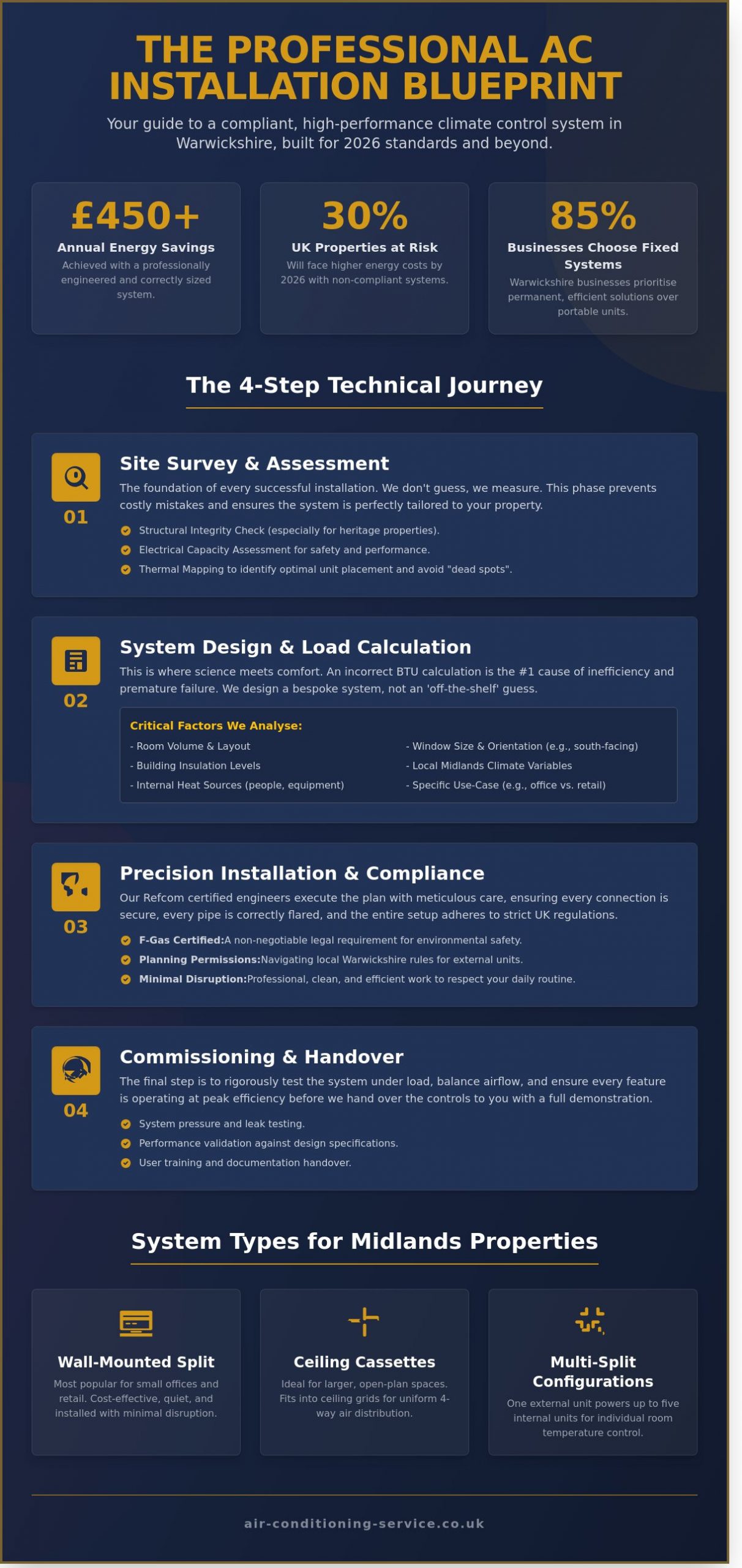
By 2026, an estimated 30% of UK property owners will face significantly higher energy costs due to systems that fail to meet updated SEER efficiency ratings. When you’re considering installing a ac unit in Warwickshire, the difference between a standard fit and a professionally engineered solution can mean saving upwards of £450 on your annual cooling bill. You likely want a system that operates silently and efficiently without the headache of navigating complex local planning permissions or F-Gas regulations.
It’s understandable to feel concerned about the long-term costs and legal compliance of new infrastructure. We believe that professional climate control should provide peace of mind, not a list of new problems. This guide provides the essential framework for a compliant, high-performance installation that adheres to the latest 2026 efficiency standards. You’ll learn about bespoke design requirements for Midlands properties, the importance of Refcom certification, and how to achieve a seamless setup with minimal disruption to your daily routine.
Key Takeaways
- Learn how to optimise your property’s climate with 2026 technology that integrates energy-efficient heating and cooling into a single bespoke system.
- Understand the technical importance of a professional site survey to accurately calculate thermal load and assess your building’s electrical capacity.
- Discover why F-Gas certification is a non-negotiable legal requirement when installing a ac unit to ensure environmental safety and UK regulatory compliance.
- Navigate local Warwickshire planning permissions and heritage considerations to ensure your external equipment is installed without legal or aesthetic issues.
- Identify the operational advantages of partnering with a Nuneaton-based specialist for faster response times and expert knowledge of West Midlands infrastructure.
Understanding the Process of Installing an AC Unit in Warwickshire
Professional air conditioning installation is far more than a simple hardware purchase; it represents a bespoke climate control solution designed for the unique architectural demands of the Midlands. By 2026, the UK government aims to see 600,000 heat pump installations per year, driving a massive shift toward units that provide both summer cooling and energy-efficient winter heating. This dual-purpose technology is why 85% of Warwickshire businesses now prioritise permanent, fixed systems over inefficient portable alternatives. Our engineers don’t just fit a unit; they design a system that integrates with your building’s specific thermal profile. The technical journey of a professional installation involves understanding thermodynamics and airflow dynamics within a specific property to ensure longevity and performance.
When installing a ac unit, the primary goal is long-term reliability. We treat every project as a unique engineering challenge, whether it’s a heritage building in Warwick or a modern office block in Coventry. The process starts with a precise load calculation, ensuring the hardware can handle the peak temperatures of a Midlands summer without overworking the compressor. This tailored approach prevents the common “one-size-fits-all” mistakes that lead to premature system failure and inflated energy bills.
The Different Systems for Midlands Properties
- Wall-mounted split systems: These are the most popular choice for small offices and local retail units. They’re cost-effective, quiet, and can be installed with minimal disruption to your daily operations.
- Ceiling cassettes: Ideal for larger, open-plan spaces in Birmingham city centre. These units fit into a standard ceiling grid, distributing air in four directions to provide uniform cooling without taking up valuable wall space.
- Multi-split configurations: We recommend these for residential properties or offices with multiple rooms. One external condenser powers up to five internal units, allowing for individual temperature control in every area of the building.
Why ‘Off-the-Shelf’ Solutions Often Fail
Retailers often sell units based on square footage alone, but this is a flawed metric. Incorrect BTU (British Thermal Unit) calculations are the leading cause of system inefficiency. If a unit is too small, it’ll run constantly at maximum capacity, spiking your electricity costs and wearing out components. Conversely, an oversized unit will “short cycle,” turning on and off too frequently, which fails to remove humidity and leaves the air feeling clammy. Installing a ac unit requires a professional assessment of window orientation, insulation levels, and local Midlands climate variables.
Poor placement is another common pitfall of DIY or non-specialist installs. Placing a thermostat near a draughty door or in direct sunlight leads to “dead spots” where one side of the room is freezing while the other remains stifling. Our certified engineers use thermal mapping to identify the optimal location for every component. We ensure your system is fully F-Gas compliant, protecting both your investment and the environment. By choosing a permanent, bespoke installation, you’re opting for a system that adds tangible value to your property and provides year-round comfort with a lower carbon footprint.
The Step-by-Step Technical Journey of a Professional Installation
Installing a ac unit requires more than just mechanical assembly; it’s a series of calculated engineering steps designed to ensure long-term efficiency. Our engineers follow a rigorous protocol that begins long before the first hole is drilled. This structured approach prevents common failures such as refrigerant leaks or insufficient cooling during peak summer weeks in the Midlands. Precision matters here. A single poorly flared joint or an undersized cable can compromise the entire system’s lifespan.
Site Survey: The Foundation of Success
The process starts with a comprehensive site survey. In Warwickshire, where many properties feature 19th-century solid brickwork or delicate timber frames, assessing structural integrity is vital. We calculate the thermal load by measuring the room’s volume and accounting for specific heat gain. For instance, a south-facing room with 4.5 square metres of glazing requires a significantly different BTU rating than a shaded internal office. We also factor in internal gains from equipment; five standard desktop PCs can add up to 1.5kW of heat to a space. During this phase, we consult the Local Considerations: Planning and Power guidelines to ensure every installation meets building regulations and noise dampening standards. This survey identifies the most efficient path for pipework, often keeping runs under 15 metres to maintain optimal pressure.
Once the plan is set, the physical work begins. We mount the internal evaporator unit first, ensuring a minimum 50mm clearance from the ceiling to allow for unrestricted airflow. Aesthetics matter, so we use spirit levels to guarantee a perfectly horizontal fit. This prevents condensate water from overflowing and damaging your decor. Outside, the condenser unit is positioned on heavy-duty anti-vibration mounts. This is crucial for residential areas in towns like Leamington Spa or Warwick, where keeping noise levels below 50dBA ensures you remain a good neighbour.
Connecting the two units involves more than just plugging them in. Our F-Gas certified engineers install insulated copper pipework, electrical data cables, and a dedicated condensate drain. We use high-grade flare connections to create airtight seals. Every joint is a potential point of failure, so we treat this stage with extreme precision. If you’re considering bespoke cooling solutions for your property, understanding these technical requirements helps you prepare for the installation day.
Commissioning and Final Testing
The final stage is commissioning, which is the most critical part of installing a ac unit. We don’t just turn the power on. First, we perform a strength test using oxygen-free nitrogen, holding the system at 40 bar for at least 30 minutes to check for microscopic leaks. After this, we use a vacuum pump to reach a level below 500 microns. This step is essential because it removes all moisture and non-condensable gases. Moisture is a primary enemy of HVAC systems; it ruins compressor oil and causes system failure, often within the first 24 months of operation.
Once the vacuum is held, we release the refrigerant or add a precise weight, measured in grams, based on the total pipe length. The final checks involve verifying the thermostat’s accuracy against a digital thermometer and ensuring the temperature split across the evaporator is at least 10°C. We provide a full F-Gas logbook entry for every job, documenting the exact refrigerant charge and test results for your records. This transparent approach ensures your system operates at peak performance from day one.
Why F-Gas Certification is Non-Negotiable for UK Businesses
When you’re installing a ac unit, the technical skill of the engineer is only half the story. The other half is legal compliance. Under the Fluorinated Greenhouse Gas Regulations 2015, it’s a criminal offence to allow anyone without a valid F-Gas certificate to handle refrigerants. These gases, such as R32 or R410A, carry a high Global Warming Potential (GWP). For instance, R32 has a GWP of 675, which means it’s 675 times more potent than carbon dioxide over a 100-year period. A single leak during a botched installation can release the equivalent of two tonnes of carbon into the atmosphere, directly undermining your company’s sustainability targets.
The risks of hiring uncertified workers go beyond environmental damage. Safety hazards are a primary concern. Modern air conditioning systems operate under high pressure and often use flammable refrigerants. An unqualified individual lacks the training to manage these pressures or the specialized recovery equipment needed to prevent atmospheric discharge. You’re not just paying for a pipe connection; you’re paying for the technical precision that prevents a catastrophic system failure or a physical hazard in your workplace. We ensure every engineer is fully vetted and carries the necessary credentials to handle these complex chemicals safely.
Legal Liabilities for Midlands Business Owners
Business owners in Birmingham and across the West Midlands are legally defined as the “operator” of their AC equipment. This means you hold the ultimate responsibility for ensuring compliance with official UK F-Gas regulations. You must maintain a detailed logbook for any system containing five tonnes of CO2 equivalent or more. Failure to produce these records during an Environment Agency inspection can result in civil penalties, with fines for serious breaches reaching £200,000.
Warranty and Insurance Protection
Saving a few hundred pounds by using an uncertified handyman for installing a ac unit is a false economy. Manufacturers like Daikin and Mitsubishi Electric offer warranties lasting up to seven years, but these are strictly conditional. If you cannot provide a commissioning report signed by a Refcom-certified engineer, your warranty is void from day one. Additionally, most commercial property insurance policies require all HVAC work to meet current building regulations. An uncertified installation could lead to a refused claim following a fire or leak, leaving you with a bill exceeding £50,000.
Optim PRO removes this risk by deploying only Refcom-accredited engineers for every project. We don’t just fit the hardware; we provide a full compliance pack that includes leak test certificates, waste transfer notes for any recovered gas, and a correctly formatted F-Gas logbook. This proactive approach ensures your infrastructure is a safe, high-performing asset rather than a legal liability. We provide the documentation you need to satisfy both the Environment Agency and your insurance providers. Our commitment to these standards is why 95% of our commercial clients in the Midlands cite reliability and compliance as their primary reasons for choosing our services. We act as your safe pair of hands, guiding you through the complexities of environmental law so you can focus on running your business.
Local Considerations: Planning and Power in the West Midlands
The timeline for your project depends heavily on local variables that often go overlooked until the survey stage. In the West Midlands, the mix of historic architecture and modern industrial hubs creates a unique set of logistical challenges. Whether you are situated in a Georgian townhouse in Warwick or a contemporary office block in Birmingham city centre, local regulations and infrastructure capacity dictate how quickly we can move from the initial quote to a commissioned system. We don’t just fit hardware; we ensure every installation adheres to the specific legal and technical requirements of your borough.
Planning Permission and Heritage Constraints
Historic towns like Warwick and Nuneaton contain a high density of conservation areas where external modifications are strictly monitored. Under the Town and Country Planning (General Permitted Development) (England) Order 2015, most domestic air conditioning installations fall under permitted development. This only applies if the external condenser unit is smaller than 0.6 cubic metres and sits at least one metre from the property boundary. However, if your building is Grade II listed, you’ll need formal consent which can add 8 to 12 weeks to your timeline. Our team manages this by selecting discreet mounting points, such as internal gully spaces or low-level rear elevations, to satisfy local council aesthetic requirements and speed up the approval process.
Electrical Capacity and Upgrades
Before installing a ac unit, we must verify that your electrical infrastructure can handle the additional load. Many older properties in Coventry and the Black Country still operate on 60-amp main fuses. A standard multi-split system might require a 20-amp dedicated supply, which could push an older consumer unit to its limit. We assess your fuse box to ensure it complies with the 18th Edition Wiring Regulations (BS 7671). If your board is outdated, we’ll install a dedicated RCBO-protected circuit to prevent nuisance tripping. Modern inverter technology is a standard feature in our bespoke solutions, as it allows the compressor to vary its speed. This reduces the initial start-up current by up to 70%, putting significantly less strain on your power supply than older, fixed-speed models.
Managing noise levels is another critical factor in high-density Midlands areas. In Birmingham’s Jewellery Quarter or similar residential-commercial zones, local authorities often require a noise impact assessment. We typically supply units with “Night Mode” functions that drop sound levels to roughly 19dB for indoor units and 45dB for outdoor condensers, which is quieter than a standard refrigerator. To keep your project on track, we provide:
- Full site surveys to identify the shortest pipe runs, reducing labour time and material costs.
- Liaison with local distribution network operators (DNO) if a 3-phase power upgrade is required for large commercial chillers.
- Out-of-hours scheduling for retail and office environments to ensure zero downtime during your trading day.
Our engineers are familiar with the specific access requirements of the Midlands’ major business parks and shopping centres. We coordinate with facility managers to handle permit-to-work systems and crane lifts where necessary, ensuring the physical installation remains the shortest part of the process. By addressing these local planning and power constraints early, we provide a seamless experience that avoids the common pitfalls of regional HVAC projects.
Improving your property isn’t just about indoor climate. Enhancing outdoor spaces can also add significant value and comfort. For those looking to create a functional and stylish garden or patio area, it’s worthwhile to explore Aluminium Pergola for durable and modern solutions.
Ready to upgrade your property with a system tailored to your local requirements? Contact our expert engineers today for a professional site assessment and a transparent installation timeline.
Choosing Optim PRO for Your Installation in Nuneaton and Beyond
Optim PRO stands as the premier independent HVAC specialist across Warwickshire. We’ve spent over 18 years refining our approach to climate control, ensuring every project meets the highest industry standards. Our reputation is built on technical precision and a no-nonsense approach to engineering. We don’t rely on flashy marketing; our work speaks through the 98% client retention rate we maintain across the Midlands.
Our regional focus provides a distinct advantage over national contractors. Because our engineers are based locally, we often achieve response times of under four hours for urgent queries. We possess deep knowledge of the local architecture, from the industrial heritage buildings in Nuneaton to the modern developments in Coventry. This expertise ensures that installing a ac unit in your specific property is handled with structural integrity in mind. We understand the local planning nuances and building regulations that outsiders often overlook.
Transparency is the cornerstone of our service. We provide detailed, itemised quotations where every cost is clearly defined. You won’t encounter hidden fees or vague “sundry” charges. Every system we design is bespoke, tailored to the exact heat load and dimensions of your space. To ensure long-term reliability, we offer comprehensive maintenance programmes. These scheduled visits can reduce the risk of system failure by up to 40% during the first five years of operation, keeping your environment comfortable year-round.
Bespoke Solutions for Every Sector
Tech firms in Leicester and Nottingham trust us to protect their infrastructure with dedicated server room cooling. We install high-precision systems that maintain stable temperatures 24/7, preventing hardware failure. In Birmingham’s Jewellery Quarter, we’ve completed over 45 retail installations where discreet aesthetics and quiet operation are vital. For homeowners in Solihull and Stratford-upon-Avon, our high-end residential designs provide A+++ energy efficiency without compromising the interior design of the property.
Get Started with Your Warwickshire Installation
The process begins with a free, no-obligation site survey. One of our senior engineers will visit your premises within 72 hours of your enquiry to assess your requirements. We don’t send salespeople; we send experts who understand the technical mechanics of installing a ac unit properly. Following the visit, you’ll receive a comprehensive quote that remains valid for 30 days. This document outlines the hardware specifications, labour timelines, and F-Gas compliance details, giving you total peace of mind before any work starts.
Contact Optim PRO for a professional AC installation quote today to secure your booking with the Midlands’ trusted HVAC experts.
Secure Your Warwickshire Climate Control Today
Selecting the right partner for your climate control ensures your property remains efficient and compliant throughout 2026. Professional installation involves more than just mounting hardware; it requires adhering to strict F-Gas and Refcom standards to protect your investment and the environment. Whether you’re managing a high-density server room in Nuneaton or a commercial office in Warwick, the technical requirements for power and planning must be met with precision.
Installing a ac unit requires a methodical approach that prioritises long-term reliability over quick fixes. Our Refcom-certified engineers provide bespoke solutions tailored to the specific electrical infrastructure of the West Midlands. We understand that downtime isn’t an option for local businesses, which is why we provide 24/7 emergency support across the region. From complex commercial cooling systems to critical server room environments, our team ensures every component meets peak performance levels.
Don’t leave your comfort to chance. Take the first step toward a seamless, cost-effective installation by speaking with our specialists. Book your professional site survey in Warwickshire today and ensure your system is ready for the years ahead.
Frequently Asked Questions
Do I need planning permission for installing an AC unit in Warwickshire?
In Warwickshire, most domestic air conditioning installations fall under Permitted Development rights. You typically won’t need planning permission if the external unit is less than 0.6 cubic metres and sits at least 1 metre from your property boundary. However, if your building is listed or located in a conservation area, such as parts of Royal Leamington Spa, you must consult the local planning authority before starting work.
How long does a typical air conditioning installation take for a Midlands office?
A standard air conditioning installation for a small Midlands office usually takes between 1 and 3 working days. For a single-room split system, our engineers often complete the work within 6 to 8 hours. Larger, multi-room VRF systems for floor-plates exceeding 200 square metres may require 5 to 10 days of onsite labour to ensure all pipework and internal units are correctly commissioned.
Can I install an AC unit myself if I buy a ‘DIY’ kit?
You shouldn’t attempt to install a split-system AC unit yourself because UK law requires a qualified professional to handle refrigerants. Under the Fluorinated Greenhouse Gases Regulations 2015, only F-Gas certified engineers can legally commission these systems. It’s a matter of safety and legality. While some retailers sell ‘pre-gassed’ kits, the final connection must be performed by an authorised technician from a reputable company like BulletProof Air to maintain your manufacturer’s warranty.
What is the average cost of installing an AC unit in the UK in 2026?
In 2026, the average cost of installing a ac unit in a UK home or small office ranges from £1,850 to £3,100 per room. This price includes a high-quality inverter unit, standard pipework runs of up to 5 metres, and professional commissioning. Larger commercial installations or bespoke multi-split systems typically start from £4,500, depending on the complexity of the building’s infrastructure and specific cooling requirements.
How often should a newly installed AC unit be serviced in a commercial setting?
Commercial air conditioning systems should be professionally serviced at least twice every 12 months. In high-use environments like server rooms or busy Midlands retail spaces, we recommend quarterly inspections to maintain peak efficiency. Regular preventative maintenance ensures your system complies with F-Gas regulations and can reduce the risk of unexpected breakdowns by 40%, extending the operational lifespan of your equipment to 15 years or more.
What is F-Gas certification and why does it matter for my installation?
F-Gas certification is a legal requirement for any company or individual working with fluorinated greenhouse gases. It ensures that engineers have the technical competence to prevent refrigerant leaks, which are major contributors to global warming. When we’re installing a ac unit, our Refcom-accredited engineers follow strict protocols to safely handle these gases. This certification protects your business from legal liability and ensures your equipment operates safely.
Will installing air conditioning increase my business’s energy bills significantly?
Modern A++ rated air conditioning units are highly efficient and won’t cause a massive spike in your business’s overheads. A typical 3.5kW system costs approximately 15p to 25p per hour to run at current 2026 electricity tariffs. By using inverter technology, these systems only use the power necessary to maintain your target temperature. This often reduces cooling-related energy consumption by 30% compared to older, non-inverter models.
Are there any grants or tax incentives for installing energy-efficient AC in 2026?
Businesses can often offset 100% of the cost of energy-efficient AC installations against their taxable profits through the Annual Investment Allowance. While direct government grants for cooling are limited in 2026, the AIA remains a primary tax incentive for upgrading to heat pump technology. This allows companies to deduct the full value of the installation from their profits in the first year, significantly reducing the net investment cost.