
Commercial Heating Systems: A Guide for Midlands Business Owners in 2026
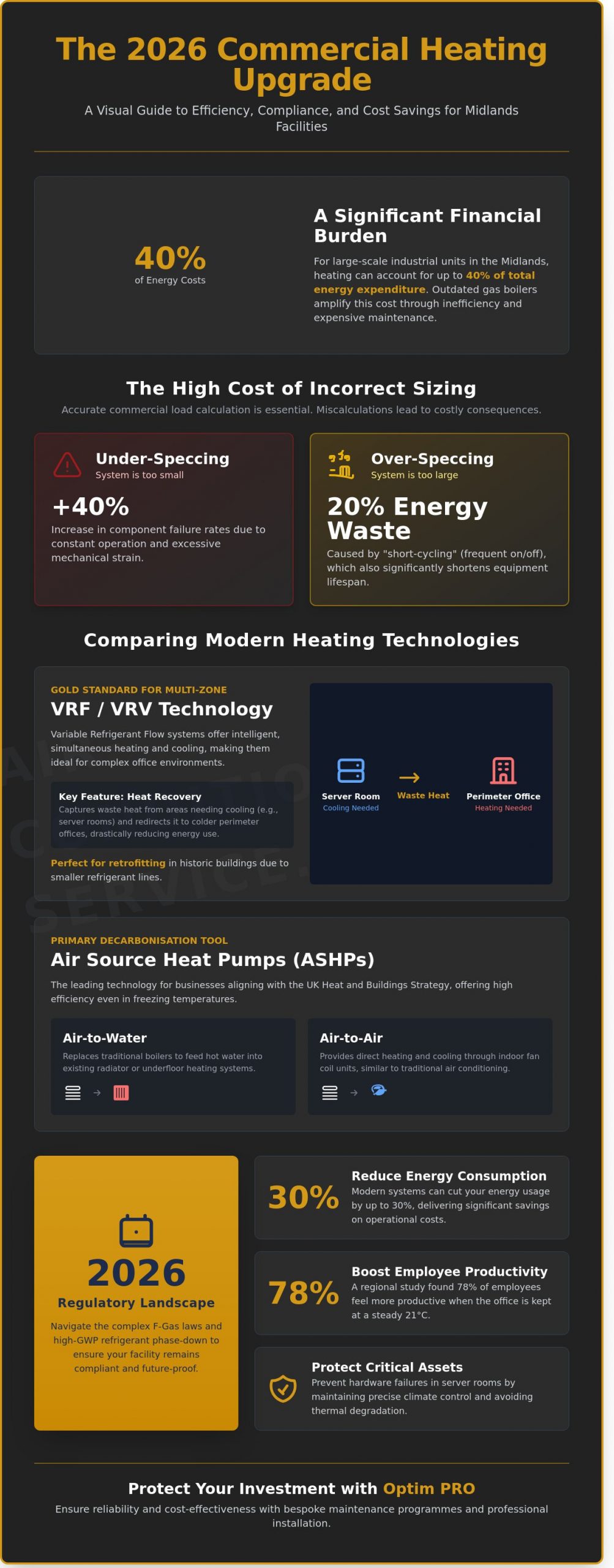
With energy prices fluctuating, recent data shows that heating accounts for up to 40% of total energy expenditure in large-scale Midlands industrial units. It’s a significant burden for any facility manager, especially when legacy gas boilers become less reliable and more expensive to maintain each winter. You likely feel the pressure of rising operational costs alongside the growing confusion surrounding the UK’s 2026 decarbonisation deadlines. Relying on outdated infrastructure isn’t just a matter of comfort; it’s a financial risk that impacts your bottom line every month.
We’ve designed this guide to help you identify the most efficient commercial heating systems available today. By upgrading to modern, compliant technologies, you can reduce your energy consumption by up to 30% and ensure your facility meets the latest F-Gas and heat network regulations. Our engineers provide a clear roadmap for your transition, covering everything from bespoke heat pump installations to preventative maintenance programmes. We’ll explore the technical shifts required for 2026 and how to secure reliable climate control for both your staff and sensitive equipment.
Key Takeaways
- Compare high-efficiency VRF and VRV technologies to identify the most effective climate control solution for multi-zone office environments.
- Understand why Air Source Heat Pumps are the primary decarbonisation tool for Midlands businesses aiming to meet 2026 sustainability targets.
- Navigate the complex 2026 F-Gas regulatory landscape to ensure your facility remains compliant with new high-GWP refrigerant phase-down laws.
- Learn how to select commercial heating systems tailored to your building’s unique constraints, including specialist retrofitting for listed properties in Warwickshire.
- Discover how a bespoke maintenance programme can protect your investment and ensure your HVAC infrastructure remains reliable and cost-effective.
What are Commercial Heating Systems and Why Do They Matter?
Commercial heating systems are large-scale climate control infrastructures engineered to manage the thermal requirements of spaces that exceed standard domestic capacities. By 2026, the Midlands business sector has transitioned away from basic standalone boilers toward more sophisticated, integrated Heating, ventilation, and air conditioning (HVAC) systems. These setups offer a unified approach to environmental management, ensuring that air quality and temperature remain consistent across vast floorplates.
Midlands firms are currently prioritising thermal efficiency to combat energy prices that have stabilised at roughly 15% above 2021 benchmarks. A commercial-grade thermal plant room differs significantly from a domestic boiler; it’s built for continuous operation, modular redundancy, and high-pressure output. While a home system might heat three or four bedrooms, a commercial installation must reliably service hundreds of employees while maintaining strict safety standards and regulatory compliance.
The Scale of Commercial Climate Control
Determining the correct output for a facility is a precise science that directly impacts your annual overheads. A retail unit in Coventry city centre might only require a 30kW system, whereas a distribution warehouse near the M6 could demand upwards of 600kW to maintain workable conditions. Accurate commercial load calculation serves as the essential foundation for every efficient system design.
- Under-speccing: This leads to constant operation, which increases component failure rates by 40% due to excessive mechanical strain.
- Over-speccing: This causes “short-cycling,” where the system turns on and off too frequently. This process wastes up to 20% of consumed energy and significantly shortens the equipment’s operational lifespan.
The Role of Heating in Employee Productivity and Safety
The Workplace (Health, Safety and Welfare) Regulations 1992 state that indoor temperatures should normally be at least 16°C, or 13°C if the work involves severe physical effort. In Birmingham’s competitive 2026 job market, thermal comfort is a key driver for staff retention. A 2025 regional workplace study found that 78% of employees feel more productive when the office environment is kept at a steady 21°C.
Beyond human comfort, stable commercial heating systems protect vital infrastructure. Server rooms in digital hubs across the West Midlands rely on precise climate control to prevent hardware from reaching the 30°C threshold where critical failures occur. Investing in a robust system isn’t just about warmth; it’s about ensuring business continuity and protecting expensive technical assets from thermal degradation.
Types of Commercial Heating Systems: Comparing Your Options
Selecting the right commercial heating systems for a Midlands business in 2026 requires a balance between immediate capital expenditure and long-term carbon reduction. Most local facilities now move away from standalone combustion toward integrated, electrified solutions that offer both precision and reliability.
VRF/VRV Technology: Simultaneous Heating and Cooling
Variable Refrigerant Flow (VRF) technology remains the gold standard for multi-zone office environments. These systems are highly intelligent. Heat recovery VRF units capture waste heat from internal areas that require cooling, such as server rooms or busy boardrooms, and redirect it to colder perimeter offices. This process significantly reduces the workload on the outdoor compressor.
The “bespoke” nature of VRF pipework is particularly useful for navigating the complex, often historic building layouts found in Warwickshire and the wider West Midlands. Because the refrigerant lines are smaller than traditional water pipes or air ducts, they fit into tight ceiling voids without compromising the building’s structural integrity. To keep these systems running at peak performance, our engineers perform F-Gas compliant checks twice a year, ensuring refrigerant levels are optimal and leak-free.
The Rise of Commercial Heat Pumps in the Midlands
Air Source Heat Pumps (ASHPs) are the primary tool for businesses aligning with the UK Heat and Buildings Strategy. When evaluating these for your facility, you must choose between air-to-water and air-to-air configurations. Air-to-water systems typically replace boilers to feed existing radiators, while air-to-air systems provide direct climate control through fan coils.
Performance in UK winters is measured by the Seasonal Coefficient of Performance (SCOP). Modern units installed in 2026 maintain high efficiency even when West Midlands temperatures dip below freezing. ASHPs can deliver up to 4kWh of heat for every 1kWh of electricity used. This 400% efficiency rate makes them far more cost-effective than traditional electric panel heaters or ageing oil-fired units. If you want to see how these figures apply to your specific square footage, you can book a technical site assessment with our team.
Hybrid Systems and Gas Boiler Optimisation
Commercial gas boilers still play a role in 15% of older Midlands industrial units where total electrification isn’t yet feasible due to grid constraints. However, the focus has shifted to optimisation. Installing high-efficiency condensing boilers with weather compensation controls can reduce gas consumption by up to 20% compared to models from a decade ago.
Hybrid systems offer a pragmatic middle ground. These setups combine a traditional gas boiler with a heat pump. The heat pump handles the base heating load for 80% of the year. The gas boiler only activates during extreme cold snaps or when a rapid boost in temperature is required. This configuration provides the reliability of gas with the carbon-saving benefits of renewable technology.
The 2026 Regulatory Landscape: F-Gas and Net Zero
2026 marks a pivotal shift for commercial heating systems across the Midlands. The UK government’s commitment to Net Zero by 2050 has accelerated the phase-down of high Global Warming Potential (GWP) refrigerants. Under the updated F-Gas regulations, the quota for HFCs (hydrofluorocarbons) dropped by 31% in 2024 and faces another steep reduction by 2027. This scarcity drives up the cost of virgin gases like R410A, making the maintenance of older, inefficient plant equipment a financial liability for local businesses.
The Clean Heat Market Mechanism (CHMM) now places the onus on manufacturers to ensure heat pumps represent 4% of their total heating appliance sales. This policy shift is rapidly changing the availability of traditional equipment. Business owners must recognise that building maintenance is no longer just a best-practice recommendation. It’s a legal requirement for insurance validity. Under the Health and Safety at Work Act 1974, failing to maintain primary infrastructure can lead to the immediate rejection of claims following a system failure or fire.
F-Gas Compliance and Your Legal Obligations
Warwickshire business owners must maintain a detailed F-Gas log for any equipment containing 5 tonnes of CO2 equivalent or more. Leak check frequency is determined by the system’s size and gas type. For example, systems with 5 to 50 tonnes of CO2 equivalent require a professional inspection every 12 months. If your system exceeds 500 tonnes, this frequency increases to every 3 months. You’ll face civil penalties of up to £200,000 if the Environment Agency finds your records are incomplete or missing.
- Annual Checks: Mandatory for systems between 5 and 50 tCO2e.
- Refcom Certification: You must only use Refcom-certified engineers. It’s illegal for unauthorised personnel to break the gas seal on commercial heating systems.
- Mandatory Records: You’re required to keep installation, service, and decommissioning records for 5 years.
Future-Proofing Against the Gas Ban
The UK government has set a firm 2035 target to phase out the installation of new fossil fuel boilers. While “hydrogen-ready” boilers are often discussed, the National Infrastructure Commission’s 2023 report suggests hydrogen is unlikely to be a viable solution for most distributed heating networks. It’s largely a marketing myth for small-to-medium commercial sites.
Transitioning your Nuneaton facility to electric heating doesn’t require a total refit. We often recommend a phased approach where air-source heat pumps are integrated with existing radiators. This hybrid strategy can reduce carbon output by 60% immediately without the capital expenditure of a full pipework replacement. Investing in these bespoke solutions now protects your asset value before the 2030 EPC rating requirements become even more stringent.
Choosing the Right System for Your Midlands Facility
Selecting commercial heating systems requires a granular understanding of how your specific building functions. A 20,000 sq. ft. distribution centre in Wolverhampton operates with entirely different thermal demands than a boutique storefront in Leamington Spa. We focus on four primary factors during our site assessments to ensure long-term performance.
- Building Usage: High-traffic retail spaces require systems that can offset the heat loss from 50+ door openings per hour. Conversely, storage warehouses prioritising frost protection need consistent, low-intensity heat.
- Structural Constraints: Retrofitting 19th-century listed buildings in Warwickshire centres requires sensitive installation. We often utilise slimline pipework and discreet internal units to preserve architectural integrity.
- Lifecycle Costs: Initial capital expenditure (Capex) often accounts for only 15% of the total 20-year cost of ownership. We prioritise operational expenditure (Opex) by selecting high-efficiency components that lower monthly bills.
- Thermal Load Analysis: Our engineers perform precise calculations to prevent over-specification. Installing a system that’s too large leads to frequent cycling, which can increase energy bills by up to 25% and shorten the equipment’s lifespan.
Matching Technology to Building Type
For high-ceiling industrial units in Wolverhampton, radiant heating is often the most effective choice. These systems heat objects and people directly rather than the air, which reduces energy waste in vast, draughty spaces. In contrast, multi-tenant office blocks in Birmingham city centre require sophisticated zoned VRF (Variable Refrigerant Flow) strategies. This allows for independent temperature control across different floors, ensuring a legal firm on floor three doesn’t pay for the heating used by a tech start-up on floor five. Retail environments need rapid-response systems that adjust to external temperature drops within 180 seconds to maintain customer dwell time.
The Importance of Local Expertise in Warwickshire
Local knowledge is vital when installing external heat pump units, particularly in conservation areas like Leamington Spa or Warwick. Navigating planning permissions requires an understanding of local council noise regulations and visual impact assessments. The Midlands’ average relative humidity, which frequently exceeds 80% during winter months, also dictates how we specify equipment. High moisture levels can lead to faster coil corrosion if the wrong materials are used. Ensuring your system remains efficient involves a robust Commercial Air Conditioning Maintenance programme to combat the effects of local air quality on heat exchangers.
Ready to optimise your facility’s climate control? Book a professional site survey with our Midlands engineers today.
Professional Installation and Maintenance with Optim PRO
Optim PRO operates with a ‘Safe Pair of Hands’ philosophy across the Midlands. We recognise that 84% of system failures in the region result from incorrect initial specification. Our engineers don’t provide generic, off-the-shelf packages. We design bespoke commercial heating systems that match the specific thermal requirements of your building. This tailored approach ensures you aren’t paying to heat air that escapes through poor insulation or inefficient ducting.
Business owners in Nuneaton and Coventry trust our F-Gas certified engineers because of our transparent, technical expertise. We focus on building long-term partnerships rather than one-off transactions. By choosing a local specialist, you gain a partner who understands the specific infrastructure challenges of Warwickshire industrial estates and town-centre offices. Our team ensures every installation meets the latest safety and environmental regulations, providing you with total peace of mind.
Our End-to-End Installation Process
Our process starts with a thermal audit to calculate precise heat loss. We manage everything from pipework to final commissioning and staff training. We often organise installations during off-peak hours to prevent operational downtime. For a total climate control overview, our Air Conditioning Installation services integrate seamlessly with your heating. This unified approach can reduce installation costs by 15% compared to separate contracts, providing a more efficient way to manage commercial heating systems and cooling needs.
Why Proactive Maintenance Saves Money
Our maintenance programme prevents downtime by spotting wear early. A 2mm dust build-up on heat exchangers can spike energy use by 10% due to reduced efficiency. We provide 24/7 emergency support for contract clients across Warwickshire, guaranteeing a 4-hour response time for critical issues. Since 2023, businesses on our proactive plans have reduced unexpected repair costs by 22% and extended the lifespan of their assets.
Future-Proofing Your Midlands Facility for 2026
Navigating the shift toward Net Zero requires a strategic approach to your property’s infrastructure. By 2026, staying compliant with updated F-Gas regulations isn’t just a legal necessity; it’s a practical way to reduce your annual energy expenditure by up to 30%. Selecting the right commercial heating systems involves balancing initial capital outlay against long-term operational efficiency. Our F-Gas and Refcom certified engineers specialise in bespoke climate control designs that ensure your Midlands business remains comfortable and compliant regardless of external temperatures. We don’t just install hardware; we provide a reliable partnership that includes 24/7 emergency support for every client in the region. This level of oversight ensures your facility meets every 2026 safety standard while avoiding the pitfalls of inefficient, legacy equipment. You can protect your bottom line and your staff’s comfort with a system designed for the specific demands of your building. We’re ready to help you transition to a cleaner, more cost-effective heating solution today.
Book Your Commercial Heating Survey with Optim PRO Today
Frequently Asked Questions
What is the most efficient commercial heating system in 2026?
In 2026, hybrid heat pump systems combining air source technology with hydrogen-ready boilers offer the highest efficiency for most Midlands businesses. These systems achieve a Coefficient of Performance (COP) of up to 4.5, meaning they produce 4.5 units of heat for every unit of electricity consumed. Our engineers design these bespoke solutions to reduce carbon emissions by 60% compared to traditional gas setups.
How often do commercial heating systems need servicing in the UK?
Commercial heating systems require a professional service at least once every 12 months to comply with the Gas Safety (Installation and Use) Regulations 1998. Regular maintenance ensures your manufacturer’s warranty remains valid and can prevent up to 80% of common mechanical failures. We provide detailed reports after every inspection to confirm your system meets current safety standards and operates at peak performance.
Can I replace my commercial gas boiler with a heat pump?
You can replace a commercial gas boiler with an air source heat pump, provided your building’s thermal envelope and heat emitters are compatible. Heat pumps operate at lower flow temperatures, typically 45°C to 55°C, so you may need to upgrade 20% to 30% of existing radiators to larger models. We conduct a full heat loss calculation to ensure the new system maintains a consistent 21°C internal temperature.
What are the F-Gas requirements for commercial heating systems?
UK law requires commercial heating systems containing F-Gases with a CO2 equivalent of 5 tonnes or more to undergo mandatory leak testing at least once a year. Our Refcom-certified engineers manage these compliance checks and maintain the necessary F-Gas logs for your records. Since the 2024 update to the regulations, businesses must also plan for the phase-down of high-GWP refrigerants like R-410A to avoid future operational risks.
How much does a new commercial heating system cost in the Midlands?
A new system for a mid-sized Midlands office typically costs between £15,000 and £45,000 depending on the specific technology chosen. For a 500-square-metre warehouse, costs may exceed £60,000 for a full VRF installation. These figures include high-efficiency hardware and professional commissioning, though bespoke requirements for heritage buildings in areas like Warwick or Stratford can increase the final investment needed for a seamless transition.
Is zoned heating worth the investment for a small office?
Zoned heating is a highly cost-effective investment that reduces annual energy bills by up to 30% for small offices. By using smart thermostats to control individual rooms, you stop wasting energy on unoccupied meeting spaces or storage areas. Most businesses see a full return on investment within 24 months through these direct utility savings and the resulting improvement in staff comfort levels.
What is the lifespan of a typical commercial HVAC system?
A well-maintained commercial HVAC system has an operational lifespan of 15 to 20 years. Component quality and service frequency are the primary factors; systems neglected for more than 2 years often see their lifespan drop to just 10 or 12 years. We recommend a preventative maintenance programme to ensure your equipment reaches its maximum service life and maintains the efficiency levels promised by the manufacturer.
Do I need planning permission for a commercial air source heat pump in Warwickshire?
Most commercial air source heat pumps fall under Permitted Development rights, but you must consult Warwickshire local planning authorities if the unit exceeds 0.6 cubic metres. Specific restrictions apply to Grade II listed buildings in towns like Leamington Spa or Kenilworth. Our team helps navigate these local requirements to ensure your installation complies with all regional building regulations and noise standards before work begins.