A failed air conditioning unit on the hottest day of the year is rarely just a comfort issue. For a business, it can mean disrupted staff productivity, unhappy customers, overheated IT equipment, closed areas of a building and an urgent expense that was never budgeted. Knowing when should AC units be replaced allows facilities teams to plan around operations rather than react to failure.
Replacement is not always the right answer. A well-maintained system can often deliver reliable service for many years, and a targeted repair may be the most cost-effective option. The decision should be based on the asset’s condition, repair history, efficiency, refrigerant position and the consequences of downtime for your site.
When should AC units be replaced rather than repaired?
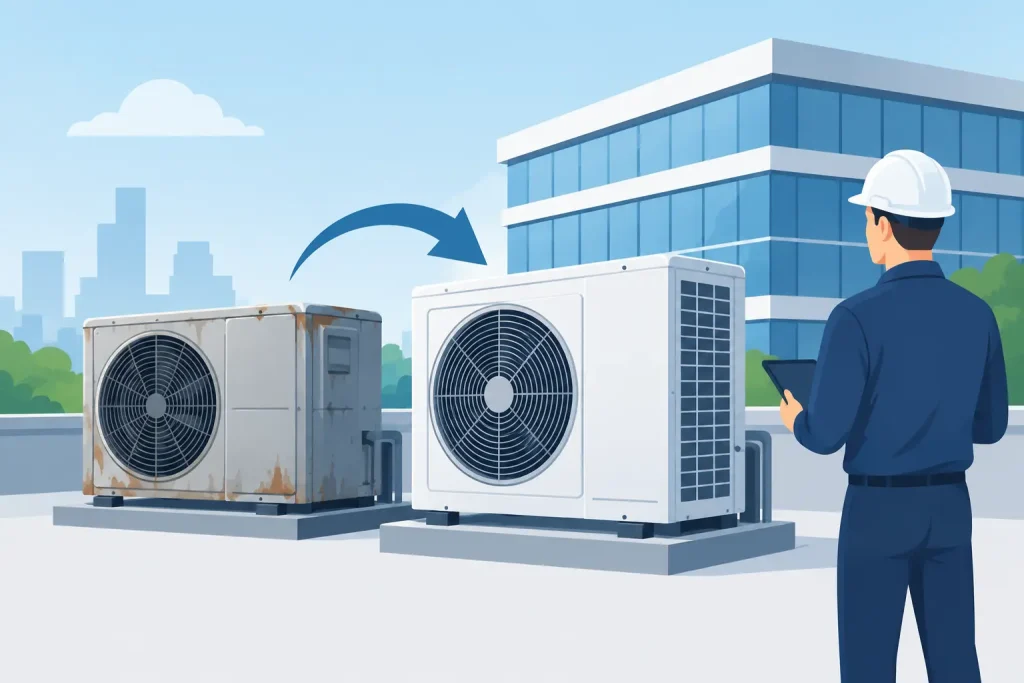
There is no single age at which every system should be removed. As a broad guide, commercial air conditioning equipment often has a working life of around 10 to 15 years, although this can be shorter in demanding environments and longer where planned preventative maintenance has been consistently carried out.
Age alone is not the deciding factor. A 12-year-old unit serving a lightly used office may still be a sensible asset to retain. Conversely, a seven-year-old system in a busy kitchen, retail site or comms room may be under enough strain to justify early replacement. The key question is whether continued repairs offer value, reliability and compliance, or merely postpone a more disruptive failure.
Replacement should move up the agenda when recurring faults begin to affect operations, repair costs rise, energy consumption becomes difficult to justify, or key components are no longer readily available. At that point, the conversation changes from fixing a fault to managing asset risk.
Five signs your air conditioning system is nearing replacement
1. Repairs are becoming frequent or increasingly costly
One isolated repair does not mean a system has reached the end of its life. Compressors, fan motors, controls and electrical components can fail for different reasons, and many faults can be resolved economically.
The warning sign is repetition. If call-outs are becoming routine, the same issue keeps returning, or several major components have failed within a short period, the system may no longer be dependable. This is particularly significant for premises with little tolerance for downtime, such as server rooms, healthcare settings, hospitality venues and occupied offices.
A useful approach is to compare the likely cost of repairs over the next 12 to 24 months with the cost of replacement. This should include more than the invoice for parts and labour. Consider emergency call-out costs, staff disruption, temporary cooling arrangements, lost trading and the management time required to deal with repeated failures.
2. Energy bills are rising without a clear operational reason
Older or poorly performing units often consume more electricity to achieve the same cooling output. Dirty coils, refrigerant issues, worn fans, poor controls and ageing compressors can all reduce efficiency. In some cases, the fault can be corrected through servicing or repair. In others, the underlying technology has simply become less economical than current equipment.
This matters where systems run for long hours or serve larger floor areas. A more efficient replacement can reduce ongoing operating costs, particularly when paired with correctly sized equipment, zoning controls and a maintenance programme that protects performance.
Do not assess energy use in isolation. Changes to occupancy, operating hours, internal heat loads or building layout can also affect consumption. A site survey can establish whether the problem is the unit itself, the system design, or how the building is now being used.
3. The unit uses an ageing or restricted refrigerant
Refrigerant availability is a major consideration for commercial air conditioning assets. Certain older refrigerants are subject to restrictions, phase-down measures or rising costs, which can make future repair less practical even where the mechanical condition of the system is reasonable.
If a unit develops a refrigerant leak, the immediate priority is to identify and repair the leak properly rather than repeatedly top up the system. Where the refrigerant is costly, difficult to source or no longer suitable for long-term support, replacement may offer greater certainty.
For duty holders, this is also a compliance issue. F-Gas obligations include leak checking requirements for applicable systems, maintaining records and ensuring work is completed by appropriately certified engineers. A planned replacement programme gives organisations more control over these obligations than an emergency decision made during a breakdown.
4. Comfort, cooling capacity or air quality is no longer adequate
If certain areas are consistently too warm, too cold or slow to reach the required temperature, the cause may be a repairable fault. It may also indicate that the system is no longer correctly matched to the building.
Businesses change. An office may add more staff and equipment. A shop may alter its layout. A warehouse may introduce a new process. A meeting room may become a permanent workspace. These changes increase heat loads and can expose limitations in an older installation.
Poor performance should therefore prompt a wider review. Replacing like-for-like equipment without checking capacity, pipework condition, controls and ventilation requirements can repeat the original problem. The right solution may be a replacement unit, a revised system design, or a combination of cooling and heat recovery ventilation improvements.
5. Parts, support or warranty protection are becoming limited
Equipment that is difficult to repair is a growing operational risk. Manufacturers may discontinue components, lead times may lengthen, and compatible replacement parts may not provide the same long-term confidence as original items.
Warranty is also relevant for newer systems. Skipping required maintenance can undermine manufacturer warranty terms and allow minor defects to develop into expensive failures. Before approving a replacement, review the servicing record. A documented history helps establish whether the existing unit has been maintained correctly and supports a more informed decision on repair versus renewal.
A practical replacement decision for commercial sites
The best replacement decisions are planned before the system becomes critical. Start with an asset review covering the age and model of each unit, condition, repair history, refrigerant type, service records and the areas it supports. For multi-site operators, this creates a clear picture of which assets present the greatest operational and financial risk.
Next, consider the consequence of failure. A unit cooling a low-occupancy meeting room has a different priority from one supporting a data cabinet, production process, retail floor or customer-facing reception. Critical units may justify proactive replacement even if they are still operating, simply because the cost of unplanned downtime is too high.
Budgeting should cover installation, electrical work, access requirements, commissioning, disposal of old equipment and ongoing maintenance. It is also worth allowing for any building changes that will improve the new system’s value, such as controls upgrades, zoning or better ventilation. A lower initial purchase price is not always the lowest whole-life cost.
Why planned replacement protects business continuity
Emergency replacement limits choice. It can force a business to accept available equipment, inconvenient installation dates and temporary disruption during a period when the building needs cooling most. Planned work can be scheduled around trading hours, tenant activity, production periods or quieter seasonal windows.
It also gives decision-makers time to assess efficiency, capacity and compliance properly. Rather than replacing a failed unit with the nearest equivalent, you can select a system that reflects current occupancy, future expansion and the operational demands of the site.
For landlords and facilities managers, a forward replacement plan can make capital spending more predictable. Instead of facing multiple unexpected failures, assets can be prioritised according to condition and risk. This approach supports better tenant comfort, protects critical environments and reduces the pressure placed on maintenance budgets.
Maintenance can delay replacement, but not indefinitely
Planned preventative maintenance remains the most effective way to extend the service life of air conditioning equipment. Cleaning coils and filters, checking electrical connections, testing controls, monitoring refrigerant circuits and identifying wear early all protect efficiency and reliability.
However, maintenance is not a reason to keep an uneconomic asset in operation forever. Its purpose is to provide accurate condition information, reduce avoidable failures and help you choose the right time to invest. If the unit is repeatedly unreliable, inefficient or difficult to support, a replacement plan is usually the more responsible operational decision.
Optim PRO can assess the condition and service history of commercial air conditioning systems across the Midlands, helping businesses distinguish between a sensible repair and an asset that needs a planned replacement. A clear site assessment gives you the evidence needed to protect comfort, compliance and continuity before a breakdown makes the decision for you.