
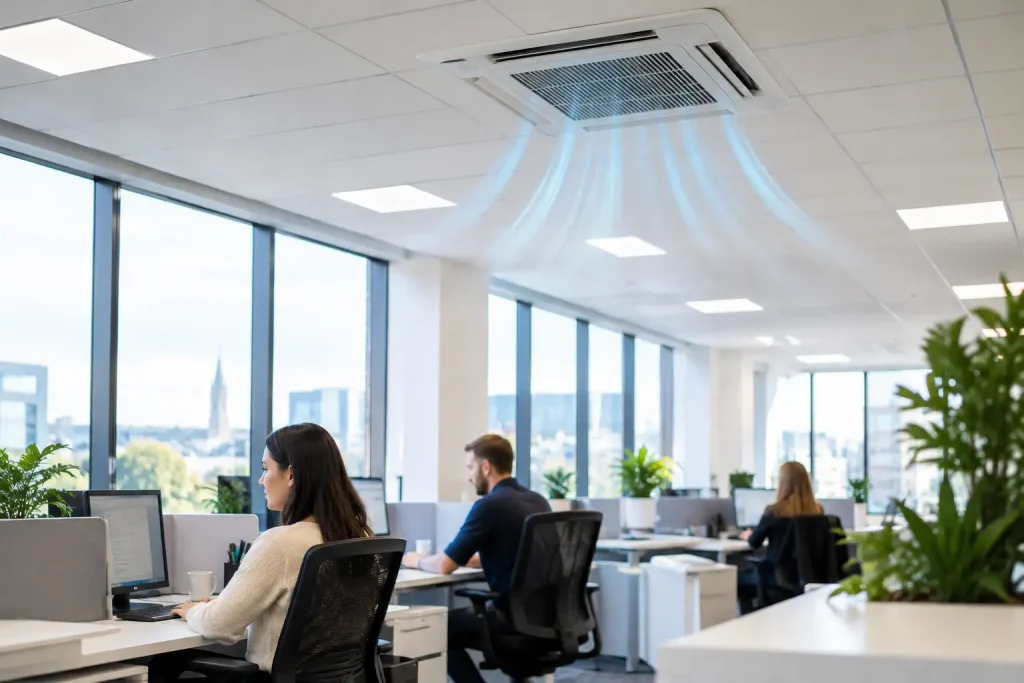
A useful office ventilation example is not simply a ceiling grille supplying cool air. It is a complete system that brings in, distributes and extracts air at the right times, while the air conditioning controls temperature without creating draughts, noise or preventable energy waste. For facilities managers, the practical test is simple: do occupants have a consistently comfortable place to work, and can the system be maintained without disruptive surprises?
In many offices, ventilation and air conditioning are discussed as though they are the same thing. They are connected, but they perform different jobs. Air conditioning commonly recirculates and conditions air within a space. Ventilation introduces outdoor air and, where required by the building design, removes stale air. A well-maintained installation needs both functions to work together.
An office ventilation example in practice
Consider a hypothetical two-storey Midlands office with open-plan work areas, several meeting rooms and a reception space. The building has a ducted fresh-air unit serving the main floors, local extract from toilets and kitchenettes, and VRF indoor units providing heating and cooling. Staff report that the open-plan office is acceptable in the morning but stuffy by mid-afternoon. The largest meeting room becomes uncomfortable during longer meetings, while one area near the perimeter feels noticeably cooler than the rest of the floor.
A superficial visit might focus only on cleaning visible air conditioning filters. That may be necessary, but it does not explain the whole picture. A proper assessment would consider whether outdoor-air filters are loaded, whether dampers are moving as intended, whether supply and extract grilles are obstructed, and whether the fresh-air unit is operating to its programmed schedule. It would also examine the VRF system’s filters, coils, fan performance, controls and condensate drainage.
The cause may be one issue or several smaller ones. A dirty filter can restrict airflow. A fan belt or motor problem can reduce the volume of fresh air delivered. A control schedule may stop the ventilation unit before late meetings finish. In the meeting room, a poorly balanced supply may leave occupants close to the diffuser cold while the centre of the room receives too little conditioned air. Each problem has a different remedy, which is why diagnosis matters.
What a maintainable office system looks like
Good ventilation performance starts with design, but it is protected by access and maintenance. Filters, coils, fan sections, dampers and controls should be reachable safely. If a concealed ducted unit has no practical access panel, routine checks become difficult, and small defects can remain hidden until they affect comfort or cause a leak.
For office managers and managing agents, maintenance access is not an academic concern. A blocked condensate drain above a ceiling can lead to water staining, disruption to a meeting room and an urgent call-out. Restricted access can also mean a longer visit, more disturbance to occupants and reduced confidence that critical components have actually been inspected.
A maintainable installation should allow engineers to check the full air path. That includes the condition of filters, the cleanliness of evaporator and condenser coils where applicable, fan operation, ductwork condition that can be reasonably inspected, grilles and diffusers, condensate trays and drains, refrigerant-system performance, electrical connections and control settings. The exact scope depends on the equipment and site, but a maintenance proposal should make clear what is included rather than describing every visit as a generic service.
Fresh air and temperature need separate checks
An office can feel cool and still be poorly ventilated. Equally, it can receive adequate outdoor air but be uncomfortable because the air conditioning is not controlling temperature evenly. Looking at only one symptom can lead to the wrong repair.
For example, increasing cooling output because a meeting room feels unpleasant may make conditions worse if the real problem is insufficient fresh-air delivery when the room is occupied. Conversely, increasing ventilation fan speed without considering the heating or cooling load may introduce discomfort and higher operating costs. The proportionate response depends on the system design, occupancy pattern and findings on site.
Why planned maintenance is more than a filter clean
Filters are a visible and essential part of maintenance, but they are only one part of the job. In ducted systems, filters can be out of sight above ceilings or within plant areas, and neglected filters can restrict airflow gradually enough that users only notice once rooms become uncomfortable.
Planned preventative maintenance gives an engineer the opportunity to identify developing faults before they become a major interruption. During a properly scoped visit, the engineer can review reported issues, inspect equipment condition, test operation and record actions or recommendations. This creates a clearer maintenance history, which is particularly valuable where a building has changed hands, equipment has been altered over time or previous servicing records are incomplete.
For a hotel, the operational consequences may include guest complaints from inconsistent bedroom temperatures, noisy fan units or water leaks. In an office, they may involve an unusable meeting room, staff discomfort or a reactive visit during a busy period. Planned maintenance cannot prevent every breakdown, particularly on ageing equipment, but it can help reduce avoidable failures and make budgeting for equipment care more predictable.
Controls often explain recurring comfort complaints
Controls deserve more attention than they receive. A well-maintained unit can still perform badly if timers, temperature set-points, sensors or zoning controls are wrong. Occupancy patterns matter too. A system scheduled for standard office hours may not suit a site with evening meetings, weekend working or a hotel reception area operating continuously.
In the hypothetical office, an engineer may find that the fresh-air system starts too late for the first occupied period, while the VRF system operates from a separate schedule. The systems are not necessarily faulty, but they are not coordinated. Adjusting controls may be a sensible first step, provided the settings suit the building design and operating requirements.
Controls should not be changed blindly. A persistently warm zone could be caused by solar gain, an obstructed grille, a dirty coil, a failed fan component or insufficient capacity for a changed layout. Reviewing the evidence first avoids repeated adjustments that mask the underlying problem.
When to consider repair, improvement or replacement
A repair is often appropriate when the issue is isolated and the wider system remains serviceable. Examples include replacing a failed condensate pump, correcting a drainage fall, repairing a fan component or resolving a controls fault. Where filters, coils and airflow have been neglected, a thorough maintenance intervention may restore performance without major works.
However, repeated faults, difficult parts availability, poor access and an installation that no longer suits the use of the space may justify a wider discussion. If meeting rooms have been subdivided, occupancy has increased or a former cellular office has become open plan, airflow and control arrangements may no longer match the building’s needs. Replacement is not automatically the answer, but it should be considered alongside ongoing repair costs, reliability and disruption risk.
A practical recommendation should distinguish urgent work from sensible improvement. It should also explain the likely operational effect of doing nothing, so the person responsible can make an informed decision rather than reacting to the latest complaint.
Questions to ask before appointing a maintenance provider
A worthwhile PPM proposal should reflect the equipment on site. Ask whether the provider will identify each system, review access arrangements and record findings. Establish whether the visit includes checks of filters, coils, drainage, airflow, electrical components and controls, rather than assuming all equipment receives the same treatment.
It is also reasonable to ask how defects will be reported and prioritised. Clear records help a facilities manager decide what needs immediate attention, what can be scheduled and what should be monitored at the next visit. For sites across Nuneaton, Coventry, Birmingham and the surrounding Midlands, maintenance can often be planned around tenant occupancy, trading hours or hotel guest areas to reduce unnecessary disruption.
OptimPRO approaches commercial air conditioning maintenance as an assessment of the complete installation, not a superficial clean. That is particularly relevant for concealed ducted units, ceiling cassettes, multi-split equipment and VRF or VRV systems where key components may be out of sight.
If your office has uneven temperatures, stale meeting rooms, recurring leaks or an unclear servicing history, request a maintenance assessment and tailored PPM proposal. A clear view of what the system is doing now is the best starting point for more reliable comfort later.