
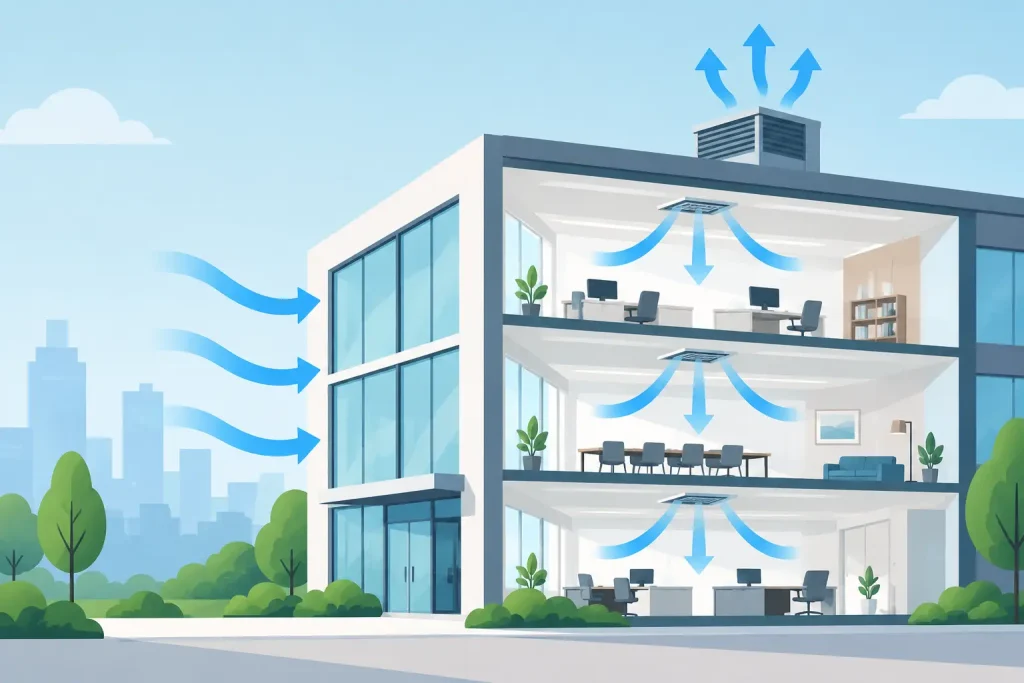
Stuffy meeting rooms, persistent condensation and rising sickness absence are not minor building issues. They can indicate that fresh-air provision is falling short of how the space is actually used. The best ways to improve ventilation start with understanding the building, its occupancy and its existing plant, then making targeted changes that protect air quality without creating avoidable energy waste.
For commercial premises, ventilation should be treated as an operational asset. A well-managed system supports employee comfort, protects stock and equipment, helps control moisture, and gives facilities teams greater confidence that their building is being run safely and efficiently.
Start with a ventilation assessment, not assumptions
Opening windows may help in a small, lightly occupied office. It is rarely a complete answer for a busy shop, restaurant, warehouse, healthcare setting or multi-let commercial property. External noise, security, pollution, weather and the building layout can all limit natural ventilation.
The first step is to assess how air currently moves through the property. This includes reviewing occupied areas, room volumes, occupancy patterns, existing extract and supply equipment, air handling units, controls, filters, ductwork and any heat recovery ventilation. Problem areas often emerge where the use of a room has changed but the ventilation strategy has not. A former storage room converted into a meeting space, for example, may now have a far higher demand for fresh air.
A professional site survey can identify whether the issue is insufficient airflow, poorly balanced airflow, blocked components, poor control settings or a system that is simply no longer suitable for the building’s needs. This avoids spending money on equipment before the root cause is clear.
Use natural ventilation where it works
Natural ventilation remains a practical option in suitable buildings, particularly smaller offices, schools, residential properties and spaces with accessible opening windows on more than one elevation. Cross-ventilation is generally more effective than relying on a single open window, because it creates a route for stale air to leave while fresh air enters.
However, it needs managing. Windows left open during cold weather can increase heating costs and create uncomfortable draughts. Ground-floor openings may raise security concerns, while premises near busy roads can introduce noise and outdoor pollutants. In these circumstances, timed window opening or secure trickle vents may be more practical than leaving windows fully open all day.
Natural ventilation should support, rather than replace, a planned approach. It is inherently variable, so it cannot provide the same dependable airflow as a correctly designed and maintained mechanical system.
Improve mechanical supply and extract ventilation
Mechanical ventilation gives building operators control where natural airflow is unreliable. Extract fans remove humid, stale or contaminated air from areas such as kitchens, toilets, changing facilities and production spaces. Supply systems introduce filtered outdoor air into occupied areas. Balanced systems do both, preventing the pressure issues that can draw odours, dust or unconditioned air through unwanted gaps in the building fabric.
The right solution depends on the premises. A retail unit may need consistent fresh-air supply for customer comfort, while a commercial kitchen requires high-performance extraction matched to cooking activity. In offices, a central air handling unit may provide the required airflow, but only if its dampers, fans, filters and controls are performing as intended.
Increasing fan speed is not automatically the answer. It can raise noise levels and electrical consumption, and it may expose restrictions in the ductwork. Airflow should be measured and balanced so each zone receives the volume it needs. This is especially relevant after refurbishment, partitioning changes or an increase in staff numbers.
Consider heat recovery ventilation for efficient fresh air
Heat recovery ventilation is often one of the most effective ways to improve ventilation in buildings that need regular fresh-air exchange without excessive heat loss. A heat recovery unit transfers warmth from outgoing stale air to incoming fresh air, reducing the energy required to heat the replacement air in cooler months.
For offices, hospitality venues, flats and well-sealed modern buildings, this can improve comfort while supporting lower running costs. It is not a fit-and-forget solution, however. Filters need changing, condensate drains need checking, and airflow rates must be commissioned correctly. A poorly maintained heat recovery system can deliver reduced airflow, noise issues and unnecessary energy use.
When considering installation, assess available plant space, duct routes, access for maintenance and the building’s occupancy profile. A smaller standalone system may suit a particular problem area, while larger or multi-zone premises may require a more integrated design.
Maintain filters, fans and ductwork
Ventilation performance often deteriorates gradually. Filters become loaded, belts wear, fan motors work harder and dampers seize in one position. Occupants may only notice once rooms become stuffy or odours linger, by which point the system may already be consuming more energy than necessary.
Planned preventive maintenance is the practical control measure. It should include inspection and replacement of filters at suitable intervals, checking fan operation, verifying belts and bearings where applicable, cleaning condensate components, reviewing electrical connections and confirming that controls respond correctly. Ductwork does not always require routine cleaning on a fixed timetable, but it should be inspected where there is evidence of contamination, reduced performance or a process that generates dust or grease.
Maintenance records matter too. Clear service documentation helps facilities managers plan expenditure, demonstrate responsible building management and identify recurring faults before they become a disruption. For systems containing refrigerant, associated air conditioning maintenance must also meet applicable F-Gas obligations and manufacturer servicing requirements.
Match ventilation rates to occupancy and use
A ventilation system commissioned for ten people will not perform adequately if twenty-five people now use the space for most of the day. Occupancy changes are one of the most common causes of poor indoor air quality in commercial buildings.
Meeting rooms deserve particular attention. They can move from empty to fully occupied in minutes, leading to a rapid build-up of carbon dioxide and a noticeable decline in comfort and concentration. Sensors can help ventilation respond to actual demand rather than operating at a fixed rate all day. Carbon dioxide monitoring is useful as an indicator of whether a space is receiving sufficient outdoor air for the number of people using it.
Demand-controlled ventilation can reduce energy consumption during quiet periods while increasing airflow when occupancy rises. The trade-off is that sensors and controls must be installed, calibrated and maintained properly. A poorly positioned sensor or incorrect setpoint can make an otherwise capable system ineffective.
Control moisture and pollutants at source
Fresh air alone cannot compensate for a poorly controlled source of moisture, odours or airborne contaminants. Extract should be located close to the source wherever possible. In kitchens, this means correctly specified canopy extraction. In shower and changing areas, it means reliable local extract. In workshops and industrial environments, local exhaust ventilation may be required to capture contaminants before they spread through the workplace.
This approach protects the wider building and reduces the airflow burden on general ventilation equipment. It also prevents common consequences of excess moisture, including condensation on glazing, mould growth, damaged finishes and complaints from tenants or employees.
Cleaning regimes, product choices and storage practices play a part. Strong cleaning chemicals, solvent-based products and poorly managed waste can all affect indoor air quality. Facilities teams should look at ventilation and housekeeping together, rather than treating them as separate issues.
Check controls, commissioning and seasonal settings
Many ventilation faults are control faults. A system may be operating outside business hours, set to a low airflow rate after a previous adjustment, or fighting against heating and cooling equipment. Building management system settings should be reviewed as occupancy patterns, opening hours and seasons change.
Commissioning is equally important after any alteration. New partitions, replacement fans, duct modifications or a change in room use can all affect air distribution. Testing and balancing confirm that supply and extract volumes are working as intended, rather than relying on what looks right at the grille.
For landlords and operators of multi-site estates, standardising checks across properties can make performance easier to manage. A structured servicing programme gives a clearer view of asset condition, filter changes, repairs and likely replacement requirements, helping to avoid unplanned downtime.
When to call a ventilation specialist
Persistent stuffiness, visible condensation, mould, unexplained odours, noisy fans, frequent overheating or rising energy consumption all justify investigation. Do not wait for a total fan failure or tenant complaint to review the system. Early diagnosis is typically less disruptive and gives more options than an urgent replacement.
Optim PRO supports Midlands businesses with practical ventilation, air conditioning and heat recovery maintenance that focuses on airflow, system condition, compliance and dependable operation. A site-led assessment can establish whether the answer is a simple maintenance correction, improved controls, refurbishment or a new ventilation strategy.
The most useful next step is to walk the building as occupants experience it. Identify the rooms that feel uncomfortable, note when the problem occurs and compare that pattern with system operation. That evidence gives your maintenance provider a clear starting point and helps turn ventilation investment into measurable improvement.