

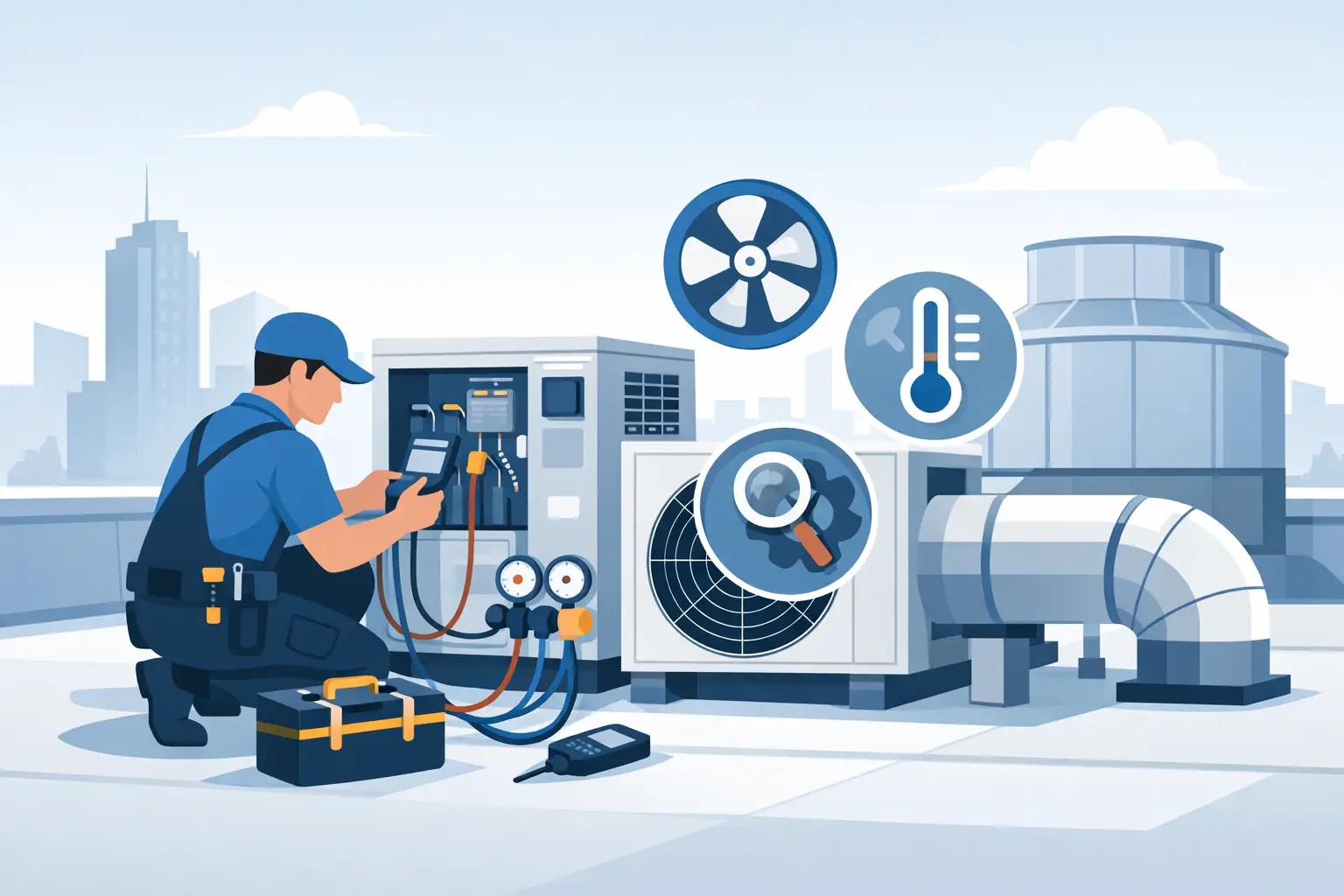
Essential Checks After Breakdowns in Commercial HVAC
A cooling or ventilation failure rarely ends when the unit starts running again. For facilities teams, the essential checks after breakdowns determine whether the site returns to stable operation or simply carries an unresolved fault into the next busy period. A rushed restart can increase energy use, compromise comfort, invalidate warranty conditions or lead to a second failure when the building can least accommodate it.
For offices, retail units, hospitality venues, warehouses and critical environments, recovery should be treated as a controlled engineering process. The immediate objective is to restore safe conditions. The longer-term objective is to establish why the system failed, prove that the repair is sound and prevent unnecessary downtime from recurring.
Make the Area Safe Before Any Restart
The first priority following an air conditioning or HVAC breakdown is safe isolation. A unit that has tripped, overheated, leaked water or lost cooling capacity may have an electrical, mechanical or refrigerant-related cause. Restarting it repeatedly in the hope that it clears can damage components further and make diagnosis less reliable.
A competent engineer should confirm the condition of the electrical supply, isolator, breakers, controls and associated equipment before work begins. Where water has escaped from condensate pipework or a drain tray, the surrounding area also needs attention. Slip risks, damage to finishes and contamination around ceiling voids can become a separate operational problem if they are ignored.
For sites with server rooms, production areas, medical equipment or temperature-sensitive stock, a temporary response plan may be required while the system is assessed. That could mean moving equipment, reducing heat loads, using temporary cooling or restricting access to affected spaces. The right response depends on the consequence of overheating, rather than the size of the air conditioning unit alone.
Confirm the Cause, Not Just the Symptom
A visible fault code or a failed component does not always identify the original cause. For example, a compressor may fail because of poor airflow, a blocked coil, unstable electrical supply, refrigerant loss or incorrect system settings. Replacing the compressor without addressing those conditions risks repeating an expensive repair.
A proper diagnostic process reviews the system as a whole. This includes operating pressures and temperatures, airflow across indoor and outdoor coils, fan operation, filters, condensate drainage, electrical connections and control signals. Engineers should also consider the recent history of the asset. Has the unit been short-cycling? Have occupants reported hot and cold spots? Has electricity consumption risen? Has planned maintenance been missed?
Check for Refrigerant Leaks and F-Gas Duties
Where refrigerant loss is suspected, the system must not simply be topped up and returned to service. Refrigerant should be handled by appropriately certified personnel, and the source of any leak should be investigated and repaired. This protects performance, reduces waste and supports F-Gas compliance.
The applicable record keeping matters just as much as the physical repair. Commercial operators should retain service reports showing the fault, work completed, refrigerant handled where relevant, test results and any recommended follow-up action. These records provide useful evidence for compliance, insurance enquiries, warranty discussions and future fault diagnosis.
Leak checks and documentation requirements vary according to the equipment and refrigerant charge. This is why a site-specific assessment is more useful than generic advice. Older systems, multi-split installations and larger VRF or VRV systems may need a more detailed review than a single small comfort-cooling unit.
Test the Repair Under Real Operating Conditions
A system can appear to work during a short attendance but still fail when demand rises. After repair, it should be allowed to operate long enough for an engineer to verify stable temperatures, pressures, current draw and airflow. Controls should be tested through the modes the building actually uses, including cooling, heating where applicable, fan operation and timed schedules.
Particular attention should be given to the components that influence system load. Dirty filters, blocked outdoor coils and failed fans can all reduce heat transfer. A condensate pump that has not been tested may stop cooling again once the tray fills. A poorly connected sensor can cause erratic operation even when the refrigeration circuit is sound.
For larger commercial systems, testing should include communication between indoor units, outdoor units, controllers and building management systems. A repair to one part of the system may expose a wider control issue. This is especially relevant in multi-zone buildings, where one fault can affect occupant comfort across several areas without creating a complete shutdown.
Review Airflow, Water Management and Indoor Conditions
Air conditioning performance is not solely about the temperature displayed on a controller. Restricted airflow forces equipment to work harder, reduces comfort and can contribute to coil icing or compressor stress. Filters, grilles, ductwork, fans and evaporator coils all need to be considered following a breakdown.
Water management deserves equal attention. Blocked condensate lines, damaged pumps and incorrectly graded drains are common causes of call-outs, particularly in systems operating for long periods during warmer weather. Clearing the immediate blockage is only part of the job. The drain route, trap arrangement and pump operation should be checked to establish whether the issue is likely to return.
Where occupants have raised concerns about odours, poor air quality or uneven temperatures, the recovery visit is an opportunity to investigate rather than dismiss them as unrelated. Dirt on coils, standing water and poor airflow can affect both system efficiency and the quality of the occupied environment.
Protect Warranty and Asset Value
Manufacturers commonly require planned maintenance and evidence of competent servicing to support warranty claims. A breakdown is therefore a sensible point to review the maintenance history, not just the invoice for the immediate repair. If filters, coil cleaning, electrical inspections or leak checks have been deferred, the cost of recovering the system may be higher than it needs to be.
The decision to repair or replace depends on several factors: equipment age, availability of parts, energy performance, repair cost, operating criticality and the likely remaining life of the asset. There is no fixed age at which replacement is automatically the right answer. A well-maintained system may justify repair, while an unreliable unit with rising running costs may be better addressed through planned replacement.
An engineer’s report should make this distinction clear. It should separate urgent remedial work from recommended improvements and longer-term capital planning, allowing facilities managers to make decisions with accurate cost and risk information.
Record the Incident and Build Prevention Into the Next Visit
Every breakdown provides data that can improve the maintenance plan. Record the date and time, affected area, symptoms reported, fault code, root cause, parts replaced, test results and any operational impact. If a site repeatedly experiences failures at the same time of year or under particular occupancy conditions, that pattern should shape servicing schedules and budget planning.
The most useful post-breakdown actions usually fall into four areas:
- bring overdue maintenance tasks forward, including filter, coil and drain cleaning;
- correct installation or control issues that contributed to the failure;
- replace vulnerable components before they fail during peak demand; and
- review whether the current servicing frequency matches how the building is used.
A small retail premises with seasonal cooling demand will need a different maintenance approach from a busy restaurant, a multi-site office estate or a data room operating around the clock. Planned preventive maintenance should reflect system type, hours of operation, environmental conditions and the business impact of lost cooling or ventilation.
When a Breakdown Needs a Wider System Review
One isolated fault may be just that. However, repeated call-outs, persistent refrigerant loss, regular electrical trips, inconsistent temperatures or escalating repair bills point to a broader issue. The cause may sit outside the failed unit, such as poor system design, inadequate ventilation, an overloaded electrical circuit, unsuitable controls or changes to how the building is occupied.
A wider review can identify whether the equipment is correctly sized, whether airflow is balanced and whether a service programme is focused on the points most likely to cause disruption. For commercial clients, this turns reactive repair information into a practical asset-management plan with clearer budgeting and fewer surprises.
Optim PRO approaches post-breakdown work with that wider operational view. The aim is not simply to get equipment running for the day, but to leave the system safe, documented and better protected against the next avoidable failure.
The strongest recovery is one that gives facilities teams confidence in the next trading day, the next period of peak demand and the condition of the asset over the years ahead.