A ventilation fault rarely starts with a dramatic breakdown. More often, it shows up as a meeting room that never feels fresh, a kitchen extract system that struggles at peak times, a retail unit with uneven temperatures, or an office where energy costs keep climbing without an obvious cause. That is where commercial ventilation maintenance services deliver real value – not as a box-ticking exercise, but as a practical way to protect airflow, compliance, equipment life and day-to-day operations.
For commercial sites, ventilation is tied directly to building performance. It affects indoor air quality, occupant comfort, energy use and, in many environments, legal responsibilities. When maintenance is reactive, small issues are allowed to build into larger faults. Filters clog, belts wear, fans lose efficiency, controls drift out of calibration and airflow drops below what the space actually needs. The cost is not limited to repair work. It can show up in staff complaints, avoidable downtime, failed inspections and shortened asset life.
What commercial ventilation maintenance services should actually cover
A proper maintenance service goes beyond a quick visual check. It should assess the condition, operation and compliance position of the system in a way that reflects how the building is used. A small office with straightforward comfort ventilation needs a different level of support from a restaurant kitchen, a warehouse, a healthcare setting or a data-led environment where cooling and air movement are critical to continuity.
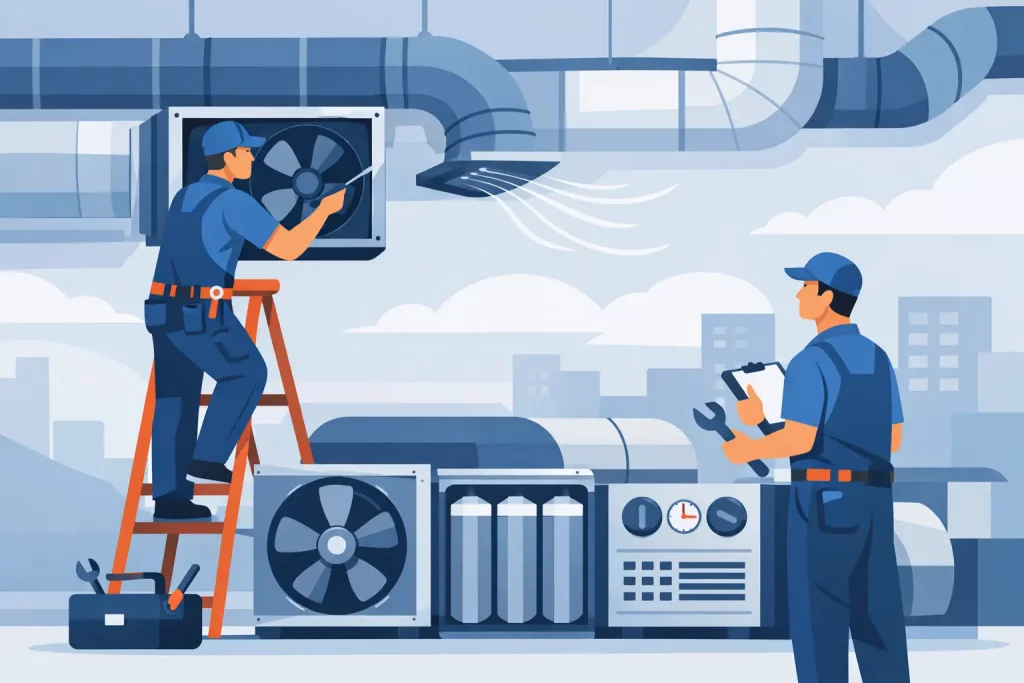
In practical terms, maintenance should include inspection of fans, motors, filters, belts, dampers, grilles, ductwork access points, controls and associated components. Airflow performance matters just as much as component condition. A system can be technically running while still underperforming, which is why checks need to focus on operational output rather than whether the unit simply switches on.
Cleaning also has a place, but it should be guided by system condition and risk rather than carried out in isolation. In some buildings, filter changes and routine cleaning will manage most of the maintenance burden. In others, particularly where grease, dust, moisture or heavy occupancy are factors, servicing needs to be more rigorous and more frequent.
Why planned maintenance usually costs less than reactive repair
The business case for maintenance is straightforward. Emergency call-outs are expensive, but the larger cost often sits around the failure rather than in the invoice itself. If a hospitality venue has to limit covers because extract performance is compromised, or a tenant raises formal complaints about air quality, or an office loses productivity because comfort conditions cannot be maintained, the financial impact escalates quickly.
Planned servicing gives businesses more control. Faults can be identified before they turn into outages. Worn parts can be replaced during scheduled visits rather than after a breakdown. Maintenance records are easier to track. Budgeting becomes more predictable. For organisations with multiple sites, that consistency is especially valuable because it reduces the chance of one neglected location creating a wider operational problem.
There is a balance to strike, though. Not every site needs the same service frequency, and overservicing is no more efficient than neglect. The right plan depends on occupancy, operating hours, system age, criticality and the consequences of failure. A light-use premises may only need a modest planned regime. A high-demand commercial environment may need a much tighter schedule to stay reliable and compliant.
Compliance is part of the job, not an added extra
One of the most common weaknesses in ventilation upkeep is treating compliance as separate from maintenance. In practice, they are closely linked. Commercial operators need confidence that systems are not only working, but that they are being maintained in a way that supports legal duties, manufacturer requirements and insurance expectations where relevant.
That can include documented servicing, condition reporting, filter changes, hygiene-related checks and clear records of remedial works. Where systems connect with wider HVAC assets, refrigerant-related responsibilities and F-Gas considerations may also come into scope. This is why many businesses prefer a single contractor that can manage maintenance, repairs and compliance support together rather than splitting responsibility across multiple suppliers.
For facilities managers and landlords, documentation matters almost as much as the engineering itself. If there is a tenant issue, an audit request or a warranty question, vague assurances are not enough. Service records need to show what was inspected, what was found and what action was taken. That creates accountability and makes future planning easier.
Commercial ventilation maintenance services and energy performance
Ventilation systems that are dirty, obstructed or poorly adjusted generally cost more to run. Fans work harder, airflow becomes less efficient and connected heating or cooling equipment may have to compensate for poor air movement. Over time, that inefficiency becomes part of the building’s baseline cost, which means operators can end up accepting avoidable waste as normal.
Routine maintenance helps correct that drift. Clean filters reduce strain. Properly tensioned belts improve performance. Controls that are checked and adjusted can stop systems operating longer than necessary or delivering the wrong output for the occupied space. On larger or more complex sites, even small performance improvements can make a noticeable difference to annual running costs.
Energy savings should be viewed realistically, though. Maintenance will not turn an ageing, poorly designed system into a high-efficiency installation. It can only help the asset perform closer to its intended standard. Where equipment is obsolete or heavily worn, the maintenance engineer should be honest about the limit of what servicing alone can achieve.
Signs your current maintenance approach is falling short
Many businesses assume their ventilation is adequately maintained because someone attends site periodically. That is not always the same as having an effective service plan. If occupiers regularly complain about stuffiness, odours or inconsistent comfort, the system may be running below requirement even if visit reports look routine.
Other warning signs include repeated fan or motor faults, frequent filter blockages, unexplained increases in energy use, visible dirt around supply or extract points, or a pattern of remedial recommendations that never seem to resolve the root issue. If maintenance is purely reactive, sites can end up trapped in a cycle of temporary fixes.
A stronger approach starts with understanding how the building is actually operating. Has occupancy changed? Have internal layouts shifted? Are operating hours longer than they were when the system was commissioned? Good maintenance support should account for those practical realities rather than relying on a fixed checklist that never changes.
Choosing the right service partner for ventilation maintenance
For commercial buyers, the right contractor is not simply the cheapest or the nearest. The more useful question is whether they can take ownership of the system in a way that reduces risk for your business. That means technical competence, of course, but it also means responsiveness, clear reporting and the ability to align service delivery with the operational needs of the site.
A competent provider should be able to explain findings in plain business terms. If airflow is dropping, what does that mean for the building? If a component is deteriorating, how urgent is the risk? If a part can be monitored rather than replaced immediately, is that a sensible saving or a false economy? Commercial clients need that level of judgement because maintenance decisions affect budget, continuity and compliance.
For organisations across the Midlands, local coverage also matters. Response times, site familiarity and continuity of support are easier to manage when the contractor works regionally and understands the demands of local commercial property portfolios. That is particularly relevant for multi-site operators who need consistency across different premises rather than a different standard of service at each location.
A company such as Optim PRO is positioned around that broader responsibility – not just carrying out servicing visits, but supporting uptime, documentation, repairs and planned asset care as a single-source climate control partner.
When a tailored servicing plan makes the most sense
Some businesses only call an engineer when there is a visible problem. That can work for very low-risk environments, but it becomes harder to justify where occupancy is high, compliance is under scrutiny or system failure would disrupt trade. Tailored servicing plans are useful because they match the maintenance level to the risk profile of the site.
An essential plan may be enough to keep a standard commercial unit inspected, cleaned and recorded at sensible intervals. A more comprehensive programme can include closer monitoring, priority response, deeper preventive work and more detailed reporting. The right choice depends on whether the priority is minimum compliance, stable budgeting, maximum asset life or protection for a critical environment.
The best maintenance programmes are built around outcomes. They should help a business avoid unplanned disruption, preserve manufacturer warranty support where applicable and make replacement decisions at the right time rather than after a preventable failure. That is the difference between maintenance as a spend and maintenance as asset protection.
Ventilation is easy to ignore when the building feels fine. The problem is that by the time performance issues are obvious, the system has often been slipping for months. A disciplined maintenance approach keeps that decline from becoming your next operational problem.