
Commercial Air Conditioning Maintenance Checklist
A failed condenser on a warm Friday afternoon rarely starts with a dramatic breakdown. More often, it starts months earlier with blocked filters, rising pressures, missed inspections or a small refrigerant issue that no one had time to chase. That is why a proper commercial air conditioning maintenance checklist matters. It gives facilities teams, landlords and operators a clear way to protect uptime, control running costs and avoid avoidable failures.
For most commercial sites, maintenance is not just a technical exercise. It affects staff comfort, customer experience, energy use, compliance records and, in some cases, whether critical spaces can keep operating at all. A retail unit losing cooling during trading hours is inconvenient. A server room, healthcare setting or production area losing temperature control can become a business continuity issue very quickly.
What a commercial air conditioning maintenance checklist should cover
A useful checklist does more than confirm that an engineer has attended site. It should show what has been inspected, cleaned, tested and recorded, and whether the system is still operating within acceptable parameters. It also needs to reflect the type of site. A small office split system and a multi-site estate with VRF equipment will not need exactly the same level of attention.
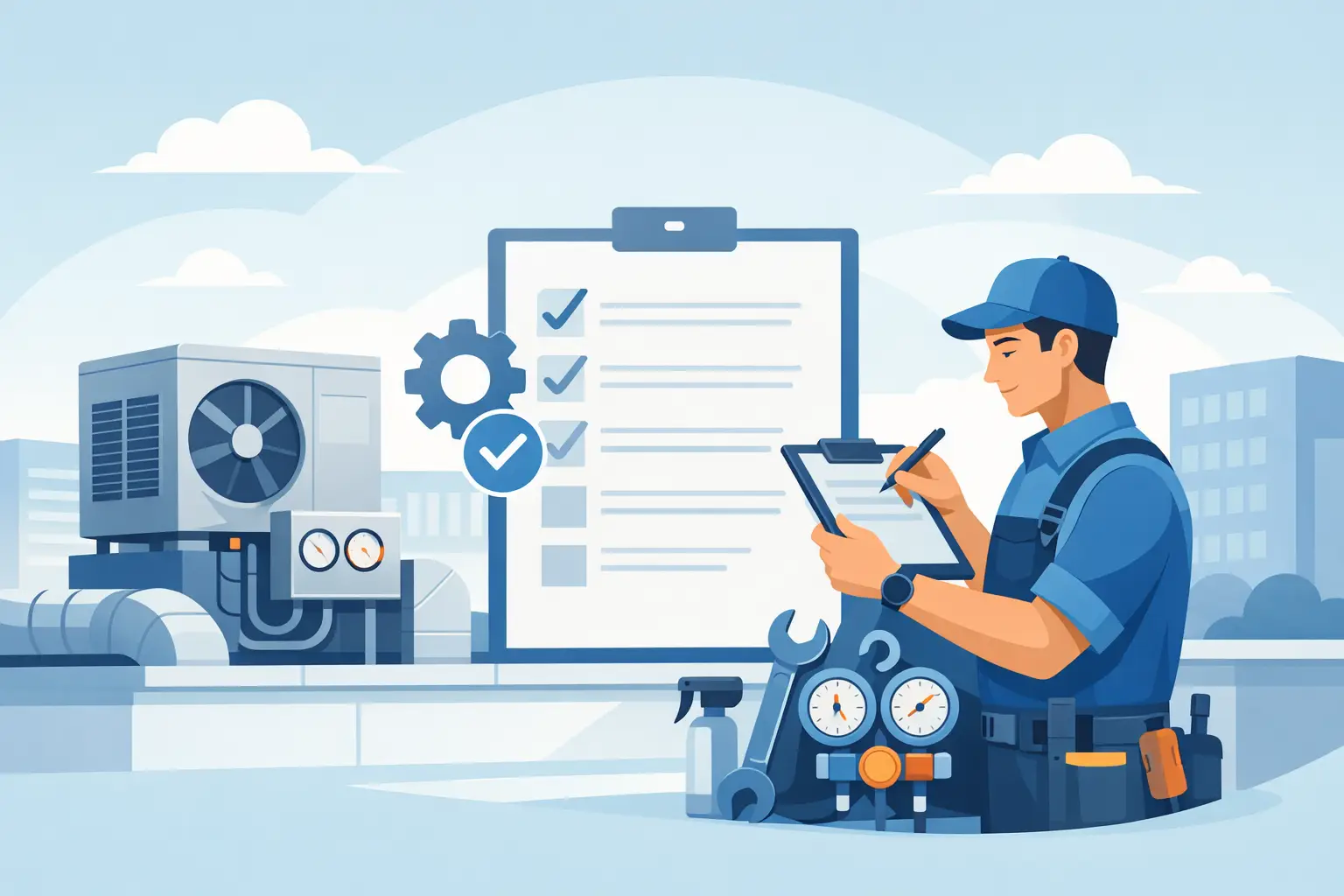
At a minimum, a commercial air conditioning maintenance checklist should cover air filters, evaporator and condenser coil condition, fan operation, condensate drainage, electrical connections, controls, refrigerant circuit performance and visible signs of wear or damage. It should also record system temperatures, pressures and any faults found during inspection.
Where relevant, compliance checks need to sit alongside routine servicing. That includes F-Gas obligations for applicable systems, service records, leak checks and evidence that maintenance is being carried out in line with manufacturer requirements. If warranty protection matters, and for most businesses it should, this paperwork is not optional.
The core checks that protect performance
Filters and airflow
Dirty filters are one of the most common causes of poor performance. They restrict airflow, reduce cooling capacity and increase strain on fans and compressors. In commercial environments with higher occupancy, dust, cooking grease or process-related particles, filters can load up far faster than people expect.
A proper visit should assess filter condition, clean or replace them as required and check whether airflow across the indoor unit remains within a sensible range. If airflow is weak, the issue may not stop at the filter. Fan motors, belts, coils and duct restrictions can all contribute.
Coils and heat exchange surfaces
Evaporator and condenser coils need to be clean enough to transfer heat efficiently. Once dirt builds up, systems have to work harder for the same output. That drives up energy use and can create knock-on faults such as icing, high head pressure or compressor overheating.
The right cleaning method depends on the equipment and contamination level. An office cassette unit with light dust is one thing. A restaurant back-of-house unit exposed to grease needs a more thorough approach. This is where a generic checklist falls short – the task should reflect the operating environment.
Condensate trays and drains
Blocked condensate drains are a classic avoidable problem. They lead to leaks, internal water damage, odours and nuisance call-outs. In ceiling voids or finished commercial interiors, a simple drain blockage can quickly become an expensive mess.
Drain lines and trays should be inspected, cleaned where needed and tested for correct discharge. If there are repeated drain issues, it may point to poor installation falls, contamination build-up or problems with condensate pumps.
Electrical components and controls
Loose terminals, worn contactors and damaged insulation are easy to miss if inspections are rushed. Yet many system failures come back to electrical wear rather than the refrigeration circuit itself. A strong checklist includes visual inspection and testing of key electrical components, along with confirmation that controllers, sensors and thermostats are operating correctly.
Control issues can be especially costly because they often look like mechanical faults at first. A site may think it has lost cooling capacity when the real issue is poor sensor placement, incorrect set-up or conflicting control logic.
Refrigerant circuit checks
Refrigerant performance should never be reduced to a quick glance. Engineers should assess pressures, temperatures and overall operating conditions to identify signs of undercharge, overcharge, airflow-related imbalance or component wear. If a system is short of refrigerant, topping it up without identifying the cause is not a maintenance strategy.
Where systems fall within F-Gas scope, leak detection and record-keeping become part of the maintenance picture. For building operators, this is about more than legal duty. Refrigerant loss reduces efficiency, undermines performance and can shorten equipment life if left unresolved.
Why compliance and warranty protection belong on the checklist
One of the biggest mistakes in commercial HVAC management is treating maintenance and compliance as separate jobs. In practice, they overlap. If servicing is irregular, undocumented or carried out without the right certification, a business can be exposed on several fronts at once.
Manufacturer warranties typically depend on documented maintenance. If a major component fails and there is no service history, support may be limited or rejected. The same applies where systems require F-Gas compliant handling and there is no clear evidence that inspections and leak obligations have been met.
For landlords, facilities managers and duty holders, the commercial point is straightforward. A good checklist protects the asset physically and administratively. It helps demonstrate that the system has been maintained properly, issues have been identified early and legal responsibilities have not been ignored.
How often should checks be carried out?
It depends on the equipment, the site and the consequences of failure. Many standard commercial systems benefit from at least two planned maintenance visits each year. That is often suitable for offices, general retail and similar occupied spaces where usage is regular but not extreme.
Higher-demand environments may need quarterly or more frequent visits. Hospitality sites, gyms, healthcare settings, IT rooms and industrial premises usually place more stress on air conditioning plant, either because of operating hours, heat loads or air quality conditions. Multi-site operators also need a programme that can be standardised enough for budgeting, while still allowing for site-specific risk.
The right answer is not always the cheapest frequency. A lighter plan may reduce short-term service spend, but if it increases call-outs, energy waste or premature component failure, the overall cost can be higher.
Turning a checklist into a maintenance strategy
A checklist is only useful if it leads to action. If repeated visits keep flagging dirty coils, unstable pressures or deteriorating electrical parts, the value comes from resolving the root cause, not simply recording the same warning again next quarter.
That is why many commercial clients move towards planned preventive maintenance rather than ad hoc servicing. A structured programme allows recurring issues to be tracked, remedial works to be prioritised and budgets to be managed more predictably. It also gives clearer visibility across estates where different systems, ages and service histories are in play.
For organisations that need a single point of accountability, working with a specialist partner can simplify that process. A provider such as Optim PRO can align routine servicing, urgent repair response and compliance documentation so the maintenance record supports both operational uptime and audit confidence. For decision-makers, that joined-up approach is often more valuable than a low-cost visit that produces little insight.
Signs your current maintenance approach is too reactive
If your team only hears about air conditioning when occupants complain, the maintenance plan is probably too thin. The same applies if there is no clear service history, no trend data on recurring faults, or no confidence around whether warranty conditions are being met.
Other warning signs include rising energy bills without a clear explanation, frequent drain issues, inconsistent temperatures between areas, systems running for long periods without reaching set point, or repeated refrigerant-related call-outs. None of these automatically means the equipment is near end of life. In many cases, they point to gaps in inspection quality, service frequency or follow-up action.
What decision-makers should ask after every service visit
A completed checklist should answer a few practical questions. Is the system operating efficiently? Are there any compliance actions outstanding? Has anything been found that could lead to failure before the next visit? And does the engineer’s report make it easier to plan spend, or has it simply confirmed attendance?
The best maintenance reporting translates technical findings into business consequences. If a fan motor is showing wear, what is the likely risk to uptime? If filters are consistently blocking early, does the visit frequency need adjusting? If a refrigerant issue is suspected, what needs to happen next and how urgent is it?
These are the details that help commercial clients make informed decisions instead of reacting under pressure.
A commercial air conditioning maintenance checklist should never be treated as paperwork for its own sake. When it is done properly, it becomes an early warning system for cost, compliance and continuity – and that is far more valuable than finding out something was missed when the building is already too warm.